


Monday, November 23, 2026

Medal of Honor Monday: Army Col. Cecil Hamilton Bolton

Left
U.S. Department of War: Feature
Medal of Honor Monday: Army Col. Cecil Hamilton Bolton
Nov. 23, 2026 | By David Vergun

During World War II, then-Army 1st Lt. Cecil Hamilton Bolton led a platoon near the Mark River in North Brabant, Netherlands, where he earned the Medal of Honor for extraordinary bravery during a fierce battle against the Nazis. 


Bolton was born to Sanders Manoah Bolton and Octavia Hamilton Bolton Oct. 7, 1908, in Crawfordville, Florida. He had two siblings, Vivian and Lloyd.

During his early childhood, the family moved to Sheffield, Alabama, where he attended public school.
He managed the Maple Grove Restaurant in Huntsville, Alabama, after moving there in 1928. He was also an amateur boxer.

Bolton married Babette DeFronch, Dec. 6, 1934, in Huntsville. She died May 19, 1939, and was buried at Oakwood Cemetery in Sheffield. Shortly thereafter, he married Bessie Mabel McNabb. 

He was drafted into the Army, July 27, 1942, in support of America's involvement in World War II. After boot camp, Bolton's aptitude test scores earned him admission to Officer Candidate School at Fort Benning, Georgia, where he earned a commission as a second lieutenant in 1943.

Bolton landed in Europe in the fall of 1944 as a first lieutenant, and by late October his unit, Company E, 2nd Battalion, 413th Infantry Regiment, 104th Infantry Division, was fighting near Wuustwezel, Belgium.

On the night of Nov. 2, 1944, he was leading the heavy weapons platoon near the Mark River in the Netherlands. Two enemy machine-gunners pinned down his company, preventing their advance while inflicting serious casualties. In the darkness, Bolton could not accurately locate the enemy's concealed positions. Still, he continued to direct 60 mm mortar fire until he was severely wounded in the legs and rendered unconscious by a German artillery shell. 


After Bolton regained consciousness, he crawled to the forward rifle platoon positions. Taking a two-man bazooka team on a voluntary mission, they advanced in chest-deep icy water along a canal toward an enemy machine-gun position. The two volunteers were Army Pfc. Wallace Worley and Army Pfc. Martin P. Specht. 

While the bazooka team covered him, he approached the hostile emplacement alone to within 15 yards. He then charged the remaining distance and killed the two gunners with hand grenades. 

Returning to his team, he led them through intense, hostile fire over open ground to assault the second German machine-gun position. An enemy sniper who tried to block the way was killed, and the trio pressed on. 

When discovered by the machine-gunners and subjected to direct fire, Bolton killed one of the three with carbine fire, and his two comrades shot the others. Continuing to disregard his wounds, he led the bazooka team toward an 88 mm artillery piece that was taking a toll on the American ranks.

They again waded through the canal until the artillery piece's silhouette became visible. Under his direction, the two soldiers knocked out the enemy weapon with rockets. 

Despite being wounded again, he refused aid and ordered Worley and Specht back to safety, while painfully crawling after them until he reached friendly lines, where he collapsed. 

Bolton's heroic assaults, inspired leadership and his continued aggressiveness, without regard for his serious wounds, contributed greatly to overcoming strong enemy resistance and made it possible for his battalion to reach its objective.

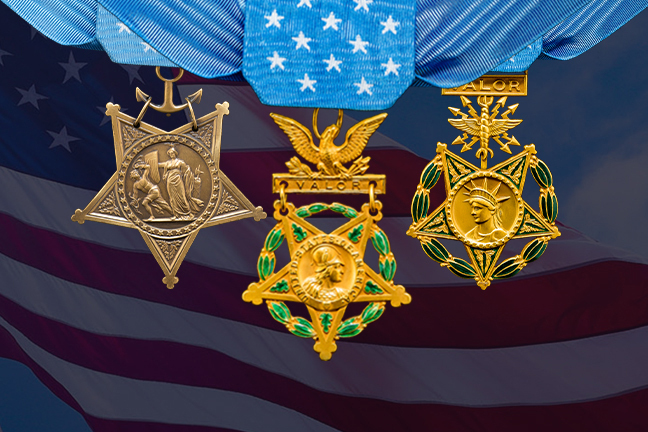
President Harry S. Truman presented the Medal of Honor to Bolton Aug. 23, 1945, during a White House ceremony. In addition to his Medal of Honor, Bolton was awarded a Silver Star Medal, a Bronze Star Medal and two Purple Hearts for his combat actions in Europe. Bolton continued his career in the Army and served at several duty stations in the U.S. from 1945-1950, rising to lieutenant colonel.

From 1950-1953, Bolton again served in combat during the Korean War, where he earned a second Bronze Star Medal. In 1962, he retired as a colonel at Fort Sam Houston in San Antonio.

Bolton died Jan. 22, 1965, at the age of 56 from a ruptured abdominal aortic aneurysm. He was buried at Fort Sam Houston National Cemetery. His second wife died April 3, 1978, and she was buried alongside him.

On Aug. 3, 2024, the Sheffield Army Reserve Center in Sheffield was renamed the Col. Cecil H. Bolton Army Reserve Center and a plaque with his Medal of Honor citation was unveiled.

"There are no questions that his valor, courage and patriotism exemplify the very best of the U.S. military," said Army Brig. Gen. Jed Schaertl, 81st Readiness Division deputy commander, who presided over the ceremony. 

"We are very proud that Col. Bolton was a product of Sheffield city schools and a citizen of the city of Sheffield," said Mayor Steven Stanley.


This article is part of a weekly series called "Medal of Honor Monday," in which we highlight one of the more than 3,500 Medal of Honor recipients who have received the U.S. military's highest medal for valor. 

Right


ABOUT   NEWS   HELP CENTER   PRESS PRODUCTS
Facebook   X   Instagram   Youtube

Unsubscribe | Contact Us


This email was sent to sajanram1986.channel@blogger.com using Granicus Communications Cloud on behalf of: U.S. Department of War
1400 Defense Pentagon Washington, DC 20301-1400

No comments:

Post a Comment