


Friday, August 21, 2026

Signers of the Declaration of Independence: Massachusetts, Part 1

Left
U.S. Department of War: Feature
Signers of the Declaration of Independence: Massachusetts, Part 1
Aug. 21, 2026 | By David Vergun


Delegates to the Second Continental Congress adopted the Declaration of Independence on July 4, 1776. The 56 delegates who signed the formal break from Britain are all considered Founding Fathers.    

Massachusetts had five delegates. This week's profile features second cousins John Adams and Samuel Adams. Their signatures are grouped in a compact block in the middle of the document, with John Hancock's signature standing out visually because of its size. 

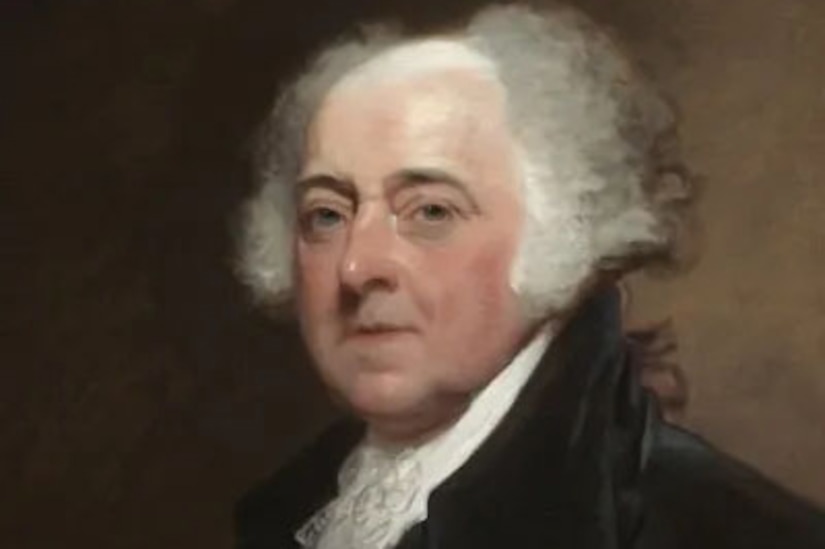
John Adams 


John Adams was born to John Adams Sr. and Susanna Boylston Oct. 30, 1735, in Braintree (later becoming part of Quincy), Massachusetts. His father was a farmer and Puritan deacon.  

Adams was the eldest of three sons, Peter Boylston and Elihu. Both younger brothers served in the Massachusetts militia during the Revolutionary War. 

Adams attended Braintree Latin School and then Harvard College, graduating in 1755. By his senior year, Adam's was leaning toward a career in law, though his father considered lawyers self-serving. 

After graduation, Adams took a teaching position at Central School in Worcester, Massachusetts, to earn money to pay for his law education. He became an apprentice to James Putnam and studied law under his supervision for two years — teaching during the day and studying law at night. He earned a master's degree in law from Harvard University and was admitted to the bar in 1758.  

On Oct. 25, 1764, he married Abigail Smith, his third cousin. They had four children who lived to adulthood: Abigail Amelia Adams, John Quincy Adams, who would later become the sixth president of the United States, Charles Adams and Thomas Boylston Adams. 

Following the British passage of the Stamp Act and Townshend Acts, Adams threw his weight behind the patriot cause, writing several pamphlets. The Stamp Act of 1765 imposed a tax on printed materials in the colonies, and the Townshend Acts, passed in 1767 and 1768, imposed additional taxes and tightened control over colonial governments. These acts led to an escalation in colonial resistance and set the stage for the American Revolution.   

Ironically, his most famous legal case was his defense of British soldiers involved in the 1770 Boston Massacre, believing that everyone should have the right to a fair trial. 

Adams was elected as a Massachusetts delegate to the First Continental Congress in 1774, where he became a leader of the faction that opposed reconciliation with Britain. In 1775, during the Second Continental Congress, he was pivotal and became known as the Atlas of American Independence, a moniker given to him by Richard Stockton, a New Jersey delegate.  

"The man to whom the country is most indebted for the great measure of independence is Mr. John Adams," Stockton said in 1776 shortly after the Second Continental Congress unanimously voted to declare independence from Britain. "I call him the Atlas of American Independence. He it was who sustained the debate, and by the force of his reasoning demonstrated not only the justice, but the expediency of the measure."

He was the primary author and drafter of the Massachusetts state constitution in 1780. 

In 1789, Adams became America's first vice president, serving under President George Washington from 1789 to 1797. On March 4, 1797, he was inaugurated as the nation's second president, serving one term. He was the first president to live in the White House.  

He was defeated by his political rival and fellow Declaration of Independence signer Thomas Jefferson. They would later renew their friendship. 

On July 4, 1826, the 50th anniversary of the Declaration of Independence, both Adams and Jefferson died. His wife died on Oct. 28, 1818. Both Adams and his wife are buried in a crypt beneath the United First Parish Church in Quincy, Massachusetts. John Quincy Adams and his wife would also be buried there later. 

The 14-acre Adams National Historical Park in Quincy, maintained by the National Park Service, includes 11 historic structures and features the birthplaces of John Adams and John Quincy Adams, the Old House at Peacefield, the United First Parish Church and the Stone Library that houses more than 6,000 rare and historically significant books collected by John Quincy Adams. 

Samuel Adams 


Samuel Adams was born to Samuel Adams Sr. and Mary Fifield Sept. 27, 1722, in Boston. His father was a merchant and brewer. His siblings were Mary and Joseph. 

He attended Boston Latin School and then Harvard College, where Adams graduated with a bachelor's degree in 1740 and a master's in 1743. 

He married Elizabeth Checkley Oct. 17, 1749. Two of their children survived to adulthood: Samuel Adams Jr., who served as an Army surgeon in the Revolutionary War, and Hannah Adams. Checkley died July 25, 1757, and Adams married Elizabeth Wells Dec. 6, 1764. They did not have children. 


Adams was deeply involved in opposition to the Stamp Act and the Townshend Acts and was a founding member of the Sons of Liberty, a group dedicated to resisting British rule through protests and boycotts. The group orchestrated and led the Boston Tea Party in 1773, a rebellion against British taxation. 

During his time in the Continental Congress, Adams helped draft key revolutionary documents while advocating for colonial rights. 

Historical accounts suggest Benjamin Franklin admired Adams for his passion and commitment to independence but also found his intensity and uncompromising approach difficult at times.  

He served on the drafting committee for the Massachusetts state constitution in 1780, providing guidance and oversight. And from 1794 to 1797, Adams was governor of Massachusetts. 

He died Oct. 2, 1803, and his wife died April 29, 1808. Adams and both wives were buried at the Granary Burying Ground in Boston. 

Adams, Massachusetts, is named for him, and there's a bronze statue of him in Boston. 

This is the 12th installment in a series of articles about the men who signed the Declaration of Independence. The 56 delegates to the Second Continental Congress, representing the 13 colonies, are all considered Founding Fathers.

Right


ABOUT   NEWS   HELP CENTER   PRESS PRODUCTS
Facebook   X   Instagram   Youtube

Unsubscribe | Contact Us


This email was sent to sajanram1986.channel@blogger.com using Granicus Communications Cloud on behalf of: U.S. Department of War
1400 Defense Pentagon Washington, DC 20301-1400

No comments:

Post a Comment