


Thursday, August 20, 2026

Learning With Every Launch: Inside Exercise Cold Raptor

Left
U.S. War Department: News
Learning With Every Launch: Inside Exercise Cold Raptor
Aug. 19, 2026 |  By Army Capt. Victoria Connell, Multi-Domain Command – Europe

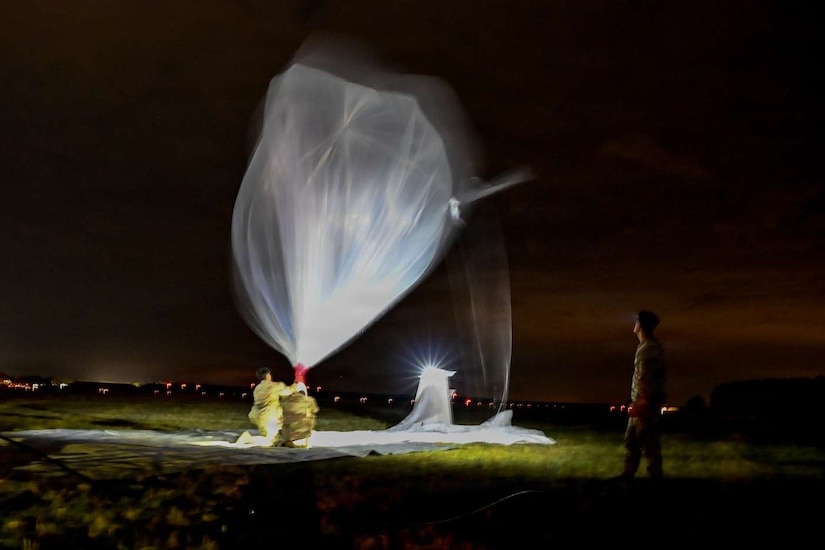
After more than 50 micro-high-altitude balloon launches over the past year, a specialized team of soldiers assigned to the Multi-Domain Command – Europe learned no two flights are exactly alike, though every launch provides lessons the team can apply to the next one.

The team recently conducted a week of balloon launches in Poland during Exercise Cold Raptor. The training supported NATO's Eastern Flank Deterrence Initiative, a NATO-led regional initiative supported by U.S. Army Europe and Africa that integrates emerging technologies to strengthen deterrence and readiness along NATO's eastern flank.

Cold Raptor gave soldiers hands-on experience launching, tracking and operating tactical balloons in a European environment while refining the procedures they will use during future missions.  

Decentralized Operations and Multidomain Readiness  

Soldiers assigned to the Extended Range Sensing and Effects Company, 2nd Multi-Domain Effects Battalion, conducted the training. Many on the team are qualified satellite communication systems operator-maintainers and are applying their signal expertise to emerging high-altitude systems.  

Army Sgt. Eric Atwater Jr., a signal sergeant, said the exercise tested the team's ability to operate from separate locations.  

"The purpose of Cold Raptor was to see how our launch team and our pilot team can operate from decentralized points," Atwater said. "We wanted to maintain communications while balloons go up in one location, while the flight trajectory is managed and monitored by another team off-site."  

For Army Sgt. Shakir Claxton, a fellow high-altitude balloon operator, improvement comes from repetition.  

"The biggest thing is getting us out in the field, setting everything up, making sure we have a solid timeframe we can work within and doing as many launches as we can," Claxton said. "The more repetitions we get, the better we get at the job."

The training also supported the company's broader multidomain mission. Claxton compared their capabilities to the three prongs of a trident, each contributing to the sensing mission.  

"We put up the balloons to give a certain kind of view of an area, while other parts of our company, like and , work hand in hand on the sensing aspect," he said.  

Adapting to Changing Conditions  

During the exercise, the team conducted launches from Powidz, Poland. Some of the balloons ascended into the stratosphere, reaching altitudes between 60,000 and 70,000 feet — approximately 18,300 to 21,400 meters — while carrying experimental payloads designed to extend communications and improve domain awareness.  

Operating in the stratosphere requires precision. Teams must account for changing weather conditions while meeting strict aviation schedules.  

"We have specific windows when these balloons need to go up to meet mission requirements," Atwater said. "Whenever we're contacting airspace control, they're expecting these terminals to be in the air at specific times. If something goes wrong, you have to think quickly on your feet, troubleshoot and find the cause in a timely manner."  

Micro-high-altitude balloon technology continues to evolve and operating the experimental equipment throughout the week presented the team with real-world challenges. By troubleshooting problems as they occurred, soldiers successfully completed flights throughout the exercise and collected data to support continued experimentation.  

The lessons learned during Exercise Cold Raptor also contribute to a broader effort to strengthen deterrence along NATO's eastern flank. The Eastern Flank Deterrence Initiative is not a single unit or location, but a distributed system of capabilities operating across domains and nations. The concept aligns land forces with NATO's regional defense plans and connects mission command systems, networks and data so allied forces can share a common operating picture and make decisions faster. Exercises like this help determine how emerging technologies can contribute to the larger effort.


"The Eastern Flank Deterrence Initiative operationalizes all-domain deterrence for NATO through a data-enabled posture that harnesses the changes in the character of war," said Army Brig. Gen. Steven P. Carpenter, commanding general of Multi-Domain Command – Europe. "Experimentation with emerging technologies allows us to better understand the operational environment, refine how we integrate capabilities across domains and strengthen our ability to deter aggression alongside our NATO allies."  

Allied Interoperability and Airspace Coordination  

Launching from Poland required more than preparing the balloons and monitoring their flights. The team also coordinated closely with Polish authorities to ensure each launch met host nation airspace requirements.  

"Airspace coordination is a major priority with this kind of mission," Claxton said. "We have an excellent communication pipeline and a strong working relationship with our Polish partners."  

That coordination extended to the flight line, where the launches drew interest from Polish partner forces. Because Polish forces had not previously worked with this type of platform in Poland, U.S. soldiers provided hands-on demonstrations of the equipment and launch process. The demonstrations allowed Polish soldiers to see the technology up close and build a shared understanding of the capability.  

For the soldiers on the ground, helping develop the emerging capability carries responsibility and opportunity.  

"Initially trained as a 25 Sierra , the Army already entrusted me to support established communications equipment," Atwater said. "Being introduced to something new and experimental is an honor. What feels like growing pains for us right now will end up being the foundation that future soldiers rely on."  

For him, the mission also connects to a childhood dream.  

"When I was a kid, I wanted to be an astronaut," Atwater said. "What I would say to my younger self is: you might not be the one going up to the stars, but you'll be the reason everyone looks to the sky and knows you sent something up to the very edge of space. They'll feel safer knowing you put it there."  

Right


ABOUT   NEWS   HELP CENTER   PRESS PRODUCTS
Facebook   X   Instagram   Youtube

Unsubscribe | Contact Us


This email was sent to sajanram1986.channel@blogger.com using Granicus Communications Cloud on behalf of: U.S. Department of War
1400 Defense Pentagon Washington, DC 20301-1400

No comments:

Post a Comment

DOW Featured Photos

...