Tuesday, April 1, 2025

Alert: Myanmar earthquake: Urgent aid needed as survivors struggle amid crisis

Welcome to the United Nations
View in browser
Click 'Download images' to view images
UN News
Global perspective Human stories
Alert 1 April 2025
Myanmar earthquake: Urgent aid needed as survivors struggle amid crisis
[UN News photo]

As Myanmar reels from a devastating earthquake, the humanitarian situation is growing increasingly dire – entire communities have been reduced to rubble, infrastructure is shattered and tens of thousands remain in urgent need of aid.

Read more
UN logo white
facebook twitter soundcloud
COPYRIGHT    |    FAQ    |    FRAUD ALERT    |    PRIVACY NOTICE    |    TERMS OF USE
Unsubscribe    |    Update preferences

Civilian Apprentice Program Feeds Navy's Shipbuilding Efforts

Left
Feature
Civilian Apprentice Program Feeds Navy's Shipbuilding Efforts
April 1, 2025 | By Katie Lange

Over the past several years, the demand for skilled tradespeople has been trending upward in the United States, especially in manufacturing and industrial trades. For civilians living near bustling military installations, it's no surprise they might find work in various trades on those bases, helping to keep warfighters at the top of their game.

Naval shipyards, for example, require very specific skills to maintain, modernize and repair massive ships. So, the service offers a few opportunities to train those civilians — initiatives that support the defense secretary's emphasis on making robust investments toward the defense industrial base.

124 Years of Excellence

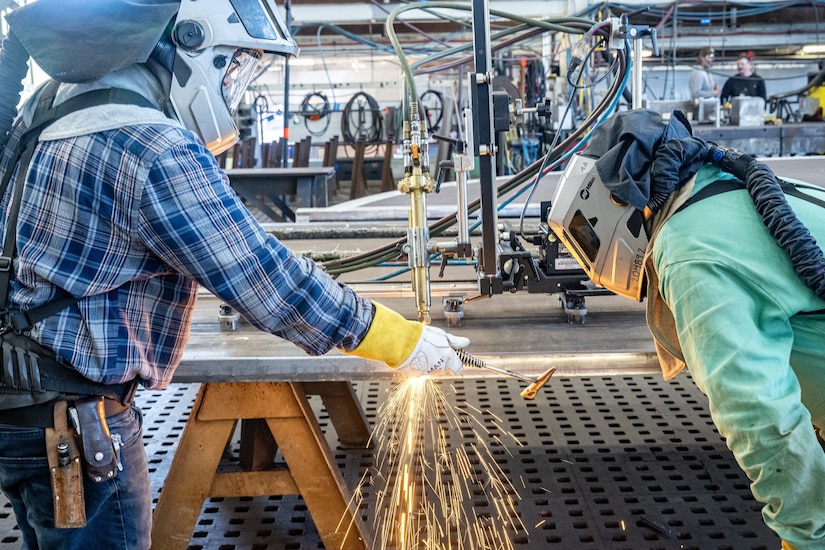
Since 1901, the civilian apprenticeship program at Puget Sound Naval Shipyard & Intermediate Maintenance Facility in Bremerton, Washington, has trained civilians in more than two dozen shipyard trades, including welding, machine operations, electrical work, rigging, painting and shipfitting. Each of these trades is key to readiness within the U.S. military.

"We have produced over 10,000 graduates through the program," said Reuben Farley, the shipyard production training superintendent for the production workforce, which oversees the apprentice program.

Farley said people who graduate from the paid four-year program work throughout the shipyard in Labor Department-certified trades, from beginner to division head positions. "It's a great way for upward mobility and to learn a trade without coming in with knowledge," he said.

Applicants must hold at least an entry-level position at the shipyard, and the program is pretty competitive. Farley said about 400-500 people apply yearly, and about 200 are selected.

Apprentice program graduates have been an asset to the shipyard for more than 120 years, not only because they leave the program with the skills and expertise needed to lead work projects but because they also showcase the dedication to learning and leadership that are essential to guiding the shipyard of the future.

The apprenticeship includes two components: classroom academics and physical training. Students take two compressed college-level classes daily during the first year, such as English, physics and math. Then, they go through about three years of robust trade theory classes accredited by the state's curriculum board.

"Painting and blasting, for instance — they will spend time talking through all the equipment they use …. then they get into more of the technical aspects of and requirements," Farley said.

For welders — dozens of whom were busy at work behind Farley during his interview — classes are focused on improving the various procedures.

"Each metal they're welding has a different process to it," Farley said. "They're also doing it upside-down in a 12-inch space, standing on their head and having to do it, like foundations in a submarine and pipes that are already in place. They've really got to be able to manipulate themselves. … It's very artistic."

The apprentices often work alongside regular work crews, which allows them to have mentors. Those who complete the program earn an associate degree in technical arts, as well as certificates from the Department of the Navy and the Labor Department.

Expanding Learning, Increasing Opportunity

Andrea Abrams, who graduated from the apprenticeship program in 2015, comes from a family of shipyard workers. Her grandfather was a welder, and her brother, father and great-grandfather were all riggers. She thought it was a cool career, so she took an entry-level job in that position, too.

"We're the ones that are hooking up all of these large items to the cranes to help lift things," she said. "We also work inside the ships."

Abrams said the apprenticeship program has taught her a lot aside from rigging.

"It's a cohort system, so it actually helps you lead others and mentor others who may be having a hard time in class," she said. "You also get to learn other trade aspects. You're taking drawing classes to learn how to do blueprints. You do classes, which are attached to that. It's pretty in-depth learning."

"Our completion rate for the program is at about 93% right now," Farley said, noting most students who go through it succeed.

He said one of the most important things the apprenticeship teaches is pride in your work.

"There are sailors that will get off a ship or a boat when you're done with it, and you don't want your work to be the problem that they have," Abrams said. "Everything you do needs to be with purpose and pride."

While an entry-level employee considering the apprenticeship may work in one particular trade, they can apply for different trades through the program.

"We might have a painter that comes in and really wants to be an electrician. will apply for the electrician apprenticeship and have the opportunity to get interviewed and selected," Farley said.

After Abrams finished her apprenticeship, she took a leadership role as an operational instructor for the program. She's now an apprentice coordinator.

"The apprenticeship, it does give you a little leg up into leadership," she said. "Out of the 700 riggers every year, there's only about 10 to 18 apprentices that year. So, there is more of a spotlight on you, and that's the same way for every class."

Abrams said the program bonded her to others in her class — something that can be useful down the road in their careers.

"You have that networking aspect," she said. "That is probably a key to the apprenticeship itself."

Right


ABOUT   NEWS   HELP CENTER   PRESS PRODUCTS
Facebook   X   Instagram   Youtube

Unsubscribe | Contact Us


This email was sent to sajanram1986.channel@blogger.com using GovDelivery Communications Cloud on behalf of: U.S. Department of Defense
1400 Defense Pentagon Washington, DC 20301-1400

Face of Defense: Behavioral Health Tech Helps Keep Sailors Mission-Focused

Left
Feature
Face of Defense: Behavioral Health Tech Helps Keep Sailors Mission-Focused
April 1, 2025 | By Katie Lange

One of the Defense Department's core priorities is restoring the warrior ethos across the military. Ensuring service men and women are in good mental health is one of the fastest ways to ensure warfighters are ready and focused on the important missions that lie ahead.  

Getting a trained, active-duty service member back into fighting shape is more efficient than training someone new. That's why behavioral health is a growing field within the military — not just for folks who need help but also for those who want to provide it.  

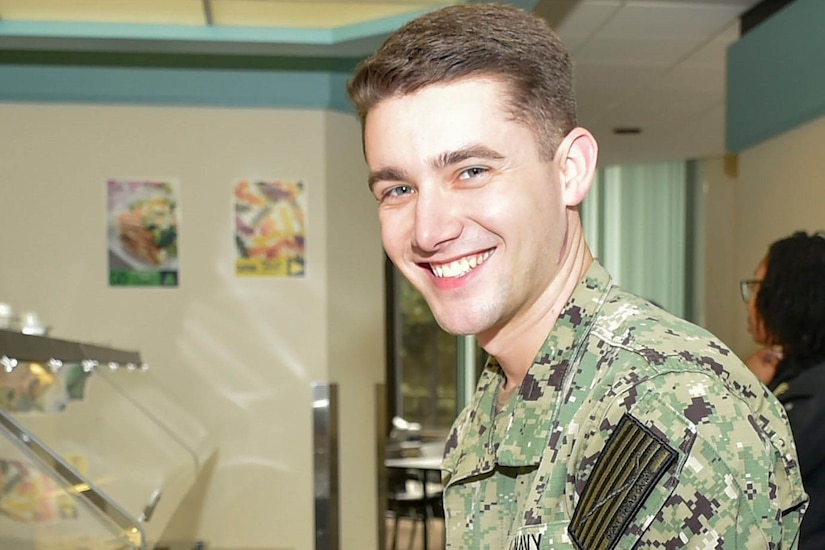
Navy Petty Officer 2nd Class Cade Crenshaw, hospital corpsman, is the leading petty officer for the mental health department and Substance Abuse Rehabilitation Program at Naval Hospital Bremerton, Washington. Five years after taking on the role of behavioral health technician, Crenshaw said he's more determined than ever to help service members remember their shared purpose and keep them in the fight.


Behavioral health technician
New Orleans
Naval Hospital Bremerton, Wash.
Mental Health Department

How did you become a behavioral health technician?

I always knew that I wanted to do something medical after high school when I joined the Navy. At Hospital Corps "A" School in San Antonio … I found out that mental health was an option, and I was like, "Hey, that sounds pretty interesting." So, I did some research, and I really got into it. 

I'm working toward my bachelor's in psychology right now and eventually commissioning because I really love this field and want to continue to do this job later in life as a psychologist. I love being able to help people. For me, to be able to see the change that I'm able to help people achieve, it means the world. 


What was your required training?

Training for BHT is done at , where the majority of the corpsman schools are. It's a five-month program that includes Navy, Army and Air Force students. You go through everything. It's like … what you would expect at any type of school. Then, in your last month, you go to clinicals. I went to a civilian inpatient facility. You interact with real patients and mental health professionals and get on-the-job experience.

What's your day-to-day role at Naval Hospital Bremerton?

I'm one of the four behavioral health technicians here in the clinic who were chosen to have an individual patient load — doing exactly what the psychologists and social workers do, sitting with the patient one-on-one. You are their therapist, which is a little unheard of for BHTs because we're not licensed. We work under the provider's license. You've got to express a great deal of confidence and expertise in your field for the providers to feel comfortable enough for you to see patients individually. 

Do you find that the behavioral health field is growing in the Navy?

It is growing. A lot of people are really, really passionate about it. … So, we're getting an influx of people wanting to go to to become a behavioral health technician.


Do you see more sailors looking for guidance? What progress has your field made?

We're continuing to and get it out there that mental health isn't this taboo subject — that it's OK to say that you're not OK.  

Some sailors are still a little concerned. There are still those negative connotations out there about it not being a physical ailment — the "you can't see that something's wrong, so it's not really wrong" type of thing. But we are seeing a lot of influx, especially with the younger generations coming through. They're like, "Hey, something's not right. I need to talk to somebody because I don't know how to fix this myself, and I need some help." So, we're definitely moving in the right direction.

Do you find it hard for some folks to open up? 

Now and then, we've got people who are like, "You're going to take away my security clearance, and I'm not going to be deployable. I can't talk to you." That's still a big factor for people — opening up and actually telling us what the root problems are. But the Navy is slowly making its way to pushing out more messaging. This isn't going to affect your deployment eligibility. This isn't going to yank your security clearance; you can still do your job. You just need some extra support, and we want to give that to you. 


What's one example of how your team has been able to help in a crisis?

One service member came in and just really high anxiety. They didn't think that they could go back and do their job — just didn't want to get out of bed in the morning. After 10 or 12 sessions with the service member working through things, getting out, and actually tackling the anxiety, we were able to return that service member to full duty, and they successfully and are now enjoying their next duty station.

What makes Bremerton's mental health program unique?

We run groups here that are technician led; so, the providers supervise us as the licensed professionals. The tech does all the care. We write and go through the curriculum and give therapy to the patients. We've got five or six different groups that we're currently running.  

And it's not like what you see in TV shows and movies where you all sit in one big circle and cry and share your deep, dark secrets. It's a classroom setting, essentially. You'll come in, and what you put into it, you'll get out of it. You can sit there and not talk for the entire hourlong group ; you can just listen if you want to. You don't have to share. But the more you give, the more you're going to get out of it. 


Explain how embedding on vessels works.

We have a lot of people at a lot of different bases … and each one's got their own set of resources. With the carriers and the submarines, they've got the embedded mental health team, which is the first line of defense for sailors assigned to those units.  

On aircraft carriers, there is one psychologist and one social worker. Then you've got your chaplain team and your deployed resiliency counselor — a civilian position that augments Navy mental health. And then there's either one or two behavioral health technicians.  

On submarines, we don't go underway with them. We, technicians, stay at the clinic. But they now have two psychologists — that just changed about a year ago. They'll go underway for a short period of time. If something happens and they need some extra support, they'll go for a day or two. But it's not the full deployment that they do because there's only two of them, and they've got several submarines to cover. 

Then there's us here at the hospital. If the can't handle it or you need something to augment your care, you'd come see us. 

What is one tip that a person could use to try to help someone who might be struggling?  

If you start to notice that somebody is not doing so great … ask the tough questions. Just have a simple conversation. Mental health — you don't have to have full, hands-on training to have a conversation. Talk to your friends, be there for them, check up on them, and just be available.

Right


ABOUT   NEWS   HELP CENTER   PRESS PRODUCTS
Facebook   X   Instagram   Youtube

Unsubscribe | Contact Us


This email was sent to sajanram1986.channel@blogger.com using GovDelivery Communications Cloud on behalf of: U.S. Department of Defense
1400 Defense Pentagon Washington, DC 20301-1400

Play Ball

Left
Photos
Play Ball
D.C. Air National Guardsmen piloting F-16s perform a flyover above Nationals Stadium, Washington, du... Photo Details >


Right


ABOUT   NEWS   HELP CENTER   PRESS PRODUCTS
Facebook   X   Instagram   Youtube

Unsubscribe | Contact Us


This email was sent to sajanram1986.channel@blogger.com using GovDelivery Communications Cloud on behalf of: U.S. Department of Defense
1400 Defense Pentagon Washington, DC 20301-1400

Ear to Ear

Left
Photos
Ear to Ear
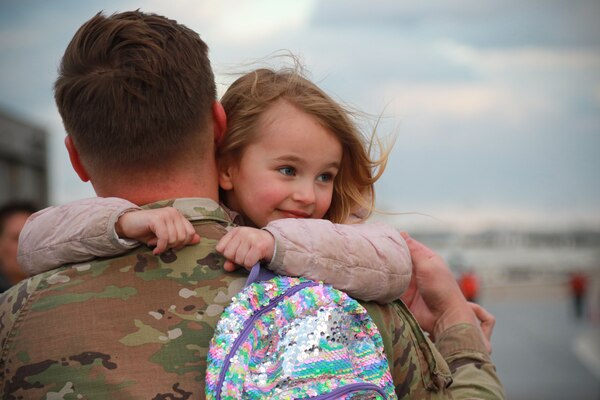
A soldier reunites with a loved one in Harrisburg, Pa., March 26, 2025, upon returning from a mobili... Photo Details >


Right


ABOUT   NEWS   HELP CENTER   PRESS PRODUCTS
Facebook   X   Instagram   Youtube

Unsubscribe | Contact Us


This email was sent to sajanram1986.channel@blogger.com using GovDelivery Communications Cloud on behalf of: U.S. Department of Defense
1400 Defense Pentagon Washington, DC 20301-1400

Graceful Approach

Left
Photos
Graceful Approach
A service F/A-18E Super Hornet assigned to Strike Fighter Squadron 94 flies toward the flight deck o... Photo Details >


Right


ABOUT   NEWS   HELP CENTER   PRESS PRODUCTS
Facebook   X   Instagram   Youtube

Unsubscribe | Contact Us


This email was sent to sajanram1986.channel@blogger.com using GovDelivery Communications Cloud on behalf of: U.S. Department of Defense
1400 Defense Pentagon Washington, DC 20301-1400