Thursday, December 5, 2024

Daily Wrap

Welcome to the United Nations
View in browser
Click 'Download images' to view images
UN News
Global perspective Human stories
Daily Wrap 4 December 2024
People gather at an UNRWA flour distribution point in central Gaza, where hunger and urgent needs persist amid the ongoing conflict.
Middle East crisis: Live updates for 4 December

The Middle East crisis continues to deepen, with families in Gaza struggling to secure basic food amid constant displacement, plummeting temperatures, and relentless conflict. Meanwhile, civil war in Syria has reignited, where the status quo has been "radically altered" in recent days, creating an "extremely fluid and dangerous" situation, says the UN Special Envoy there. Violations of the ceasefire in Lebanon are also continuing – we're covering it all live. UN News app users can follow here.

Read more
Peace and Security
Children attend an e-learning session at Abdullah Naj internally displaced people's gathering point in Port Sudan.
'Major milestone' on solutions to internal displacement: Top adviser

There have been significant advances in addressing the worldwide internal displacement crisis, but urgent action is still needed as numbers continue to rise, topping 76 million people worldwide, the top UN official on the issue said on Wednesday.

Read more
Migrants and Refugees
A two-year-old girl was seriously injured when a rocket struck her home in Lviv, Ukraine.
Ukraine: UNICEF chief urges greater protection for children 'caught in this nightmare'

The plight of children impacted by Russia's full-scale invasion of Ukraine was the focus of debate in the UN Security Council on Wednesday. 

Read more
Peace and Security
Afghanistan's humanitarian crisis is just one of many that UN aid agencies and partners fear will deteriorate without support from the international community.
Live updates: UN humanitarians highlight global needs for 2025

Every year, the launch of the Global Humanitarian Overview is an opportunity to highlight where needs are greatest and how much funding is needed to help some of the most vulnerable people on Earth. Read our live updates of events as they unfolded in Kuwait, Nairobi and Geneva, hosted by the UN's new Emergency Relief Coordinator Tom Fletcher, with highlights from humanitarians around the world, from Gaza to Ukraine. UN News app users can follow our coverage here. 

Read more
Humanitarian Aid
Siddhesh Sakore (right) works with farmers in Pune, India.
Meet the 'Land Heroes' who are fighting desertification

From planting a billion trees in Zimbabwe, in southern Africa, to exporting products from the moringa tree in Mali and developing a climate action-focused board game called "Rescuing Penguins," in Costa Rica, a group of young people has been recognized by the UN for making a positive impact in the fight to counter desertification, land degradation and drought.

Read more
Climate and Environment
Widespread destruction in Khan Younis, Gaza Strip.
305 million people need lifesaving help next year, says UN's top aid official

Multiple unending conflicts, climate change and a glaring disregard for long-established international humanitarian law are set to leave a staggering 305 million people in need of lifesaving assistance next year, the UN's top aid official warned on Wednesday.

Read more
Humanitarian Aid
UN logo white
facebook twitter youtube soundcloud
COPYRIGHT    |    FAQ    |    FRAUD ALERT    |    PRIVACY NOTICE    |    TERMS OF USE
Unsubscribe    |    Update preferences

Austin Recounts Lessons in Leadership at West Point Address

Left
News
Austin Recounts Lessons in Leadership at West Point Address
Dec. 4, 2024 | By Joseph Clark

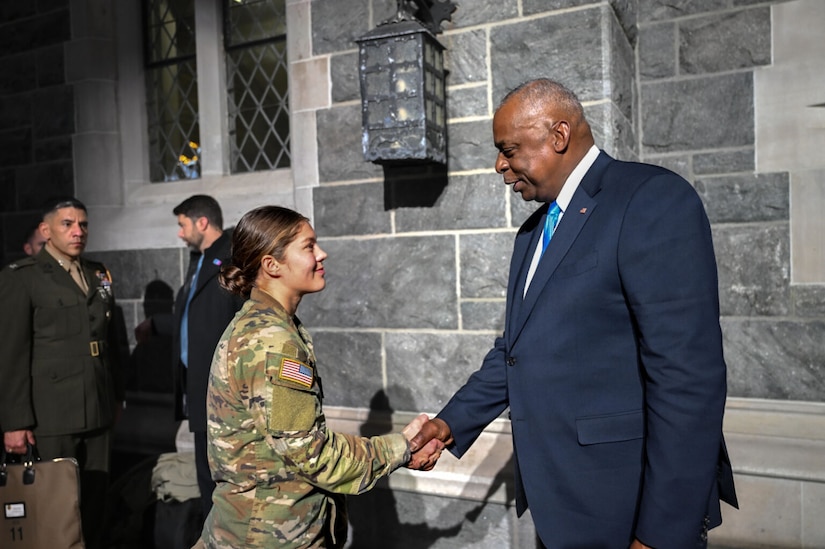
Secretary of Defense Lloyd J. Austin III today called on the next generation of Army officers to lead with courage and unwavering commitment to those women and men who have answered the call to serve.

In his address to U.S. Military Academy, West Point, New York, cadets on "Lessons in American Military Leadership," the secretary drew from his more than four decades of service in uniform underscoring that the people who fill the ranks of the nation's all-volunteer force will continue to remain as the core of the United States' warfighting prowess. 

"Over the decades, our uniforms have changed. Our weapons have changed. Our tactics have changed. But one thing won't ever change. And that's the power and the capability of our people," Austin, a member of West Point's graduating class of 1975, said. 

"You are the key to our strength and our warfighting power," he said. "And the security of the United States will always depend on two huge strategic assets: the talents and the commitment of the American people, and the values of our democracy." 

He conveyed a series of lessons learned from his nearly six years of leading in combat as he drove home the imperative of leading the nation's warfighters with conviction.

"On the battlefield, troops will only go as far as they have to for poor leaders," Austin said. "But troops will go the distance for good leaders. And I have personally seen this over and over again.  

"American soldiers will run through walls for leaders, and I mean that literally," he said. "They will do amazing things. They will show phenomenal courage. And it is more powerful than anything you'll see in any war movie." 

That intrinsic bravery permeates throughout the ranks regardless of gender, Austin said. He noted, in particular, the courage he has witnessed among women serving under his command. 

While serving as the assistant division commander for maneuver during the march on Baghdad in 2003, Austin said he decided to keep his command post close to the fight to see the situation and understand the battlefield conditions.

Shortly before crossing the line of departure, he gathered his team, including "several extraordinary women," serving in his command post to discuss what lay ahead.  

"I told my team, 'Look, we need to win this fight, so I need to be at the front,' Austin recalled. "I know what will happen to me if I'm captured. I have no intention of being captured, and I will fight to the last bullet. But the risks are serious. I am enormously proud of all of you, and that won't ever change. So, if anyone here thinks that they can't deploy forward, I fully understand. And no one will ever think any less of you." 

"The women and men of that incredible team looked at me, and finally one of the women popped up and said, 'Sir, what are you talking about,'" Austin said.  

He said despite facing the same dangers as the men, and perhaps more, the women under his command "did not flinch."

"That is who the women of the United States military are," Austin said. "Everywhere I've gone on a battlefield, I've seen women fighting for America. They are incredibly capable, incredibly accomplished, and incredibly brave." 

He also highlighted the bravery of another soldier who risked his life to save his save the members of his squad who had become pinned down by enemy fire in Iraq. 

Austin, who was deployed to Iraq as a one-star general, spoke to the unit immediately after the firefight. 

"Once we had evacuated the unit and they were out of harm's way, I approached that young soldier and I asked him, 'Hey, what made you do that? What made you run toward that automatic weapon?'" Austin said. "And I asked him, 'Weren't you afraid?'"

The soldier confirmed he was scared out of his mind, Austin said.  

"And then he said, 'But I heard my squad leader's voice, and I knew that it was going to be OK,'" Austin said.  

He said those "extraordinary patriots" that fill the ranks demand "extraordinary leadership." He called on the cadets to lead from the front and foster teamwork and confidence among the soldiers they lead.  

"We are one team. One team," Austin said. And in today's complex national-security environment, we don't have one warrior to spare." 

The secretary said the new generation of leaders are stepping up at a critical time for global security and for American ideals.  

"We face serious security challenges today: coercion from the People's Republic of China; aggression from Putin's Russia; malice from North Korea, Iran, and transnational terrorist groups; and autocrats around the world who insist that democracy's day is done," Austin said.  

He added that while the cadets will enter the Army under extraordinary circumstances, they are up to the task. 

"Believe in yourselves," he said. "And trust in the training, the education, and the confidence that you've gained here as cadets."

Right


ABOUT   NEWS   HELP CENTER   PRESS PRODUCTS
Facebook   Twitter   Instagram   Youtube

Unsubscribe | Contact Us


This email was sent to sajanram1986.channel@blogger.com using GovDelivery Communications Cloud on behalf of: U.S. Department of Defense
1400 Defense Pentagon Washington, DC 20301-1400

DOD Leverages Defense Production Act to Galvanize Critical Supply Chains

Left
News
DOD Leverages Defense Production Act to Galvanize Critical Supply Chains
Dec. 4, 2024 | By Army Maj. Wes Shinego

In the shadow of Coosa County, Alabama's pine-strewn hills, and across Nome, Alaska's rugged expanse, the Defense Department is mounting a strategic response to an urgent security challenge. Beneath these two distinct landscapes lie the BamaStar Graphite Project and the Graphite Creek deposit, which anchor efforts to rebuild America's graphite production enterprise — an undertaking critical to our military's lithium-ion batteries. These projects, supported by Defense Production Act funding, are part of a broader push to address vulnerabilities in the defense industrial base that leave the nation exposed to supply chain disruptions and adversarial influence. 

For decades, the United States has been almost entirely dependent on foreign sources for graphite — a key component in the batteries that power electric vehicles, military energy systems, and other technologies central to modern life. China, which produces 77% of the world's graphite and refines more than 90%, dominates the market. As geopolitical tensions rise, this reliance has become a glaring weakness. The 2022 Defense Department report titled "Securing Defense-Critical Supply Chains" underscores the gravity of the issue, stating: 

"To defend the nation and deter America's adversaries, the Defense Department works to ensure that our armed forces have reliable access to every advantage. Meeting that mission requires a healthy DIB (defense industrial base) built on resilient, diverse and secure supply chains." 

The United States has taken bold steps to secure its graphite supply. In February 2021, Biden's Executive Order 14017 catalyzed a comprehensive review of critical supply chains, with graphite standing out as a priority. China's 2023 export restrictions on graphite heightened the urgency, sending shockwaves through industries reliant on the mineral and underscoring the department's efforts to mitigate risk. 

Laura Taylor-Kale, assistant secretary of defense for Industrial Base Policy, who also holds a doctorate in management science and engineering, emphasized during an October 2024 briefing that world events demand a long-term shift in defense industrial strategy. "We have seen how quickly we need to ramp up capacity in response to conflict," she said. "World events have forced us to prepare for the long-term and plan differently." Taylor-Kale also highlighted the historic scope of investments in key sectors to bolster supply chains, describing them as catalysts for a myriad of additional programs and partnerships. 

Initially designed to address wartime emergencies, the DPA has evolved into a powerful tool for long-term industrial planning. Under its Title III authorities, the department has directed funds to projects like the BamaStar Graphite Project, which received $3.2 million for a feasibility study on creating a fully domestic graphite production pipeline. 

Meanwhile, Alaska's Graphite Creek, the largest known graphite deposit in America, received a $37.5 million award to accelerate development of a vertically integrated supply chain that includes advanced manufacturing and recycling. These projects represent just one part of a broader initiative to address vulnerabilities in the DIB. 

These investments reflect a strategic shift in how the department approaches supply chain security. Though historically reactive, the department is now prioritizing prudence, aligning industrial capacity with future needs rather than immediate crises. This shift extends beyond stockpiling raw materials, as it focuses on building infrastructure, partnerships and policies to ensure sustained resilience. 

Unveiled in October 2024, the National Defense Industrial Strategy Implementation Plan, is a key framework for this strategic approach. Deputy Assistant Secretary of Defense for Industrial Base Resilience Carla Zeppieri summarized its six initiatives, emphasizing the need for urgency and collaboration. One of the initiatives focuses on "managing defense production and supply chains," which includes onshoring defense-critical capabilities and enhancing cybersecurity. Zeppieri pointed to the importance of mitigating risks like single points of failure within supply chains, particularly for specialized components vital to military technologies. 

The NDIS-IP focuses on allied collaboration is another highlight. "We will leverage our respective strengths into a network of allied DIB capability for mutual effectiveness and resilience," Zeppieri noted. The framework aligns with the department's integrated deterrence strategy, especially in the Indo-Pacific region, where adversarial influence on critical materials poses a growing threat. 

During the same briefing, Taylor-Kale addressed the broader implications of this strategy "Integrated deterrence, economic security, national security and our nation's military strength are mutually reinforcing," she said. The assistant secretary also emphasized the department's commitment to measuring progress through a risk framework and detailed metrics in a forthcoming classified annex. 

The investments are already yielding results. The $37.5 million DPA investment in Graphite Creek has catalyzed plans for a $435 million processing facility and investments in other critical sectors, such as rare earth magnets and microelectronics, have spurred private-sector interest and innovation. Taylor-Kale championed these investments as examples for how "capital allocation today" translates into "exponential gains in resiliency and sustainment tomorrow." 

Supply chain disruptions — from cyberattacks to natural disasters — highlight the interconnectedness of commercial and defense supply chains. Addressing vulnerabilities is a long-term endeavor. "The ripple effects of today's investments demonstrate how tens of millions of dollars in today's industrial base investments become hundreds of millions or even billions in resiliency and sustainment," Taylor-Kale explained. 

While challenges — ranging from high costs to regulatory hurdles — remain significant, the department is committed to driving forward. In a July 2023 address, Taylor-Kale framed the stakes succinctly: "Graphite is essential to the national defense. Our investments today are about ensuring resilience and security for tomorrow." 

By leveraging tools like the DPA and fostering public and private collaboration, the United States is reasserting its leadership in critical materials and technologies. These efforts not only address immediate vulnerabilities but also lay the foundation for a more secure and prosperous future. As Taylor-Kale noted during the NDIS-IP briefing, "The evolution from strategy to implementation required lengthy discussions with key players, ensuring a unified collaboration among our partners. This marks a first for defense industrial policy." 

The road ahead demands unwavering commitment and strategic foresight to transform today's challenges into tomorrow's opportunities. But in a speech delivered at the SelectUSA Investment Summit last summer, Deputy Secretary of Defense Kathleen Hicks emphasized the sincerity with which the department regards sustainment resilience. "We care more than ever before about the security and resilience of our supply chains," she said. 

Right


ABOUT   NEWS   HELP CENTER   PRESS PRODUCTS
Facebook   Twitter   Instagram   Youtube

Unsubscribe | Contact Us


This email was sent to sajanram1986.channel@blogger.com using GovDelivery Communications Cloud on behalf of: U.S. Department of Defense
1400 Defense Pentagon Washington, DC 20301-1400

Week in Review

...