


Friday, May 1, 2026

Prussian Officer Established Drill Manual Used in American Revolutionary War

Left
U.S. Department of War: Feature
Prussian Officer Established Drill Manual Used in American Revolutionary War
May 1, 2026 | By David Vergun


Drill plays a fundamental role in the military. It serves to build discipline, obedience, unit pride and cohesion, orderly and efficient movement, honor traditions and inspire leader development. 

As America observes 250 years of freedom, here's a look back on the development of drill in the American Revolutionary War. 


The development of drill is credited to Continental Army Maj. Gen. Baron von Steuben, who taught it to soldiers at Valley Forge, Pennsylvania, at the request of Gen. George Washington, commander of the Continental Army. Von Steuben learned drill while serving in the Prussian army from 1746 to 1763 as an aide-de-camp of Frederick the Great. Incredibly, he spoke no English, only French and German, so he was always accompanied by an interpreter. 

After training the soldiers, von Steuben wrote the "Regulations for the Order and Discipline of the Troops of the United States," commonly known as the "Blue Book." This manual was the foundation of discipline, drill and ceremony in the Army. He wrote the manual in French, which was then translated into English. 

In addition to drill and ceremony instructions, the Blue Book places in writing the duties of noncommissioned officers. These updated guidelines are still in use today, in Field Manual 7-22.7, The Army Noncommissioned Officer Guide and Training Circular 3-21.5. The other services have their own NCO manuals, which share many similarities. 

This manual established the military training and maneuvers that helped the armed forces become the premier fighting force that it is today. 

Von Steuben fought in several major battles and commanded one of the three divisions of the Continental Army at Yorktown in 1781. In 1783, he helped demobilize the Army, and resigned his commission in 1784. 

After the war, he became a naturalized U.S. citizen and lived on an estate in New York's Oneida County. He was born on Sept. 17, 1730, and died Nov. 28, 1794, at the age of 64. 


Every September, von Steuben Day parades take place throughout the nation in conjunction with German festivals, including Oktoberfest. 

A number of Navy warships carried the name USS Von Steuben, the most recent being a Cold War-era ballistic missile submarine. Also, some American cities and counties bear his name, and there are statues of him in various locations. 

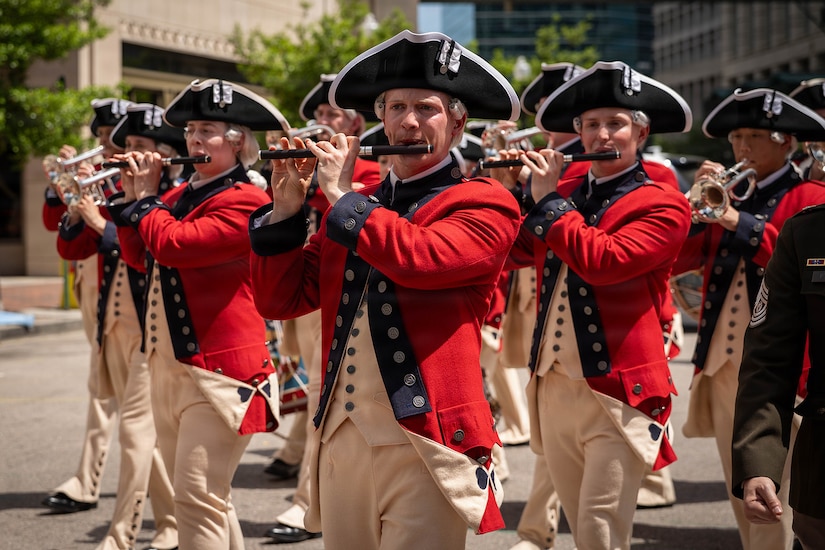
The United States Army Old Guard Fife and Drum Corps soldiers stationed at Joint Base Myer-Henderson Hall, Virginia, wear Revolutionary War period uniforms and perform drill movements that were used during that war. 

As an official representative of the Army, the Fife and Drum Corps averages approximately 500 performances annually. It has entertained millions of people in major parades, pageants and historical celebrations throughout the country and has served America as a goodwill ambassador around the world.  

The Fife and Drum Corps has performed at major sporting events including NCAA bowl games, NBA games, NFL games — including Super Bowl XVI — the Kentucky Derby, the Indianapolis 500 and the 1980 Winter Olympics in Lake Placid, New York. 

In support of the president, the Fife and Drum Corps performs for all arrival ceremonies at the White House for foreign heads of state and has participated in every presidential inauguration parade since that of President John F. Kennedy in 1961. 

Right


ABOUT   NEWS   HELP CENTER   PRESS PRODUCTS
Facebook   X   Instagram   Youtube

Unsubscribe | Contact Us


This email was sent to sajanram1986.channel@blogger.com using GovDelivery Communications Cloud on behalf of: U.S. Department of War
1400 Defense Pentagon Washington, DC 20301-1400

No comments:

Post a Comment