


Friday, July 17, 2026

Medal of Honor Recipient Welcomes Newest Student Naval Aviators

Left
U.S. War Department: News
Medal of Honor Recipient Welcomes Newest Student Naval Aviators
July 17, 2026 |  By Austen McClain

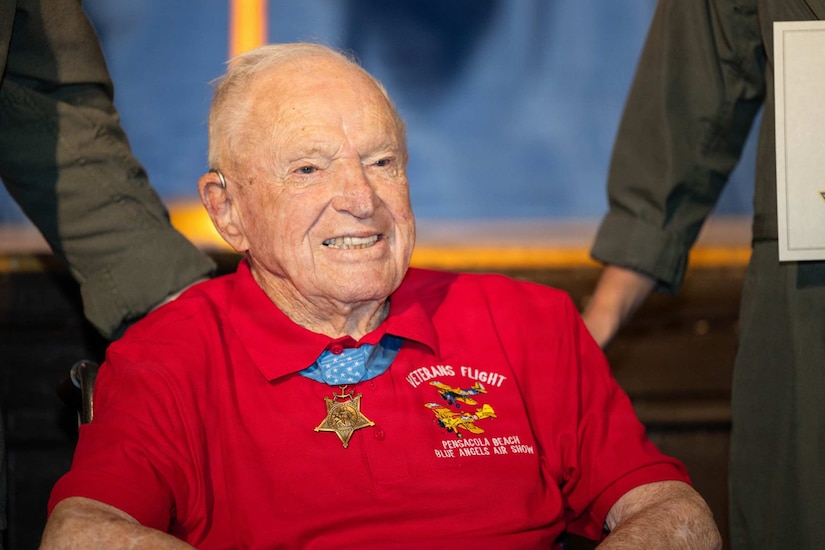
The oldest living Medal of Honor recipient returned to the base where he earned his gold wings July 15, joining Naval Aviation Schools Command in congratulating 29 student naval aviators who completed their introductory flight evaluation training, the first milestone on the path to those same wings.

Retired Navy Capt. E. Royce Williams, 101, enlisted during World War II and earned his wings at Naval Air Station Pensacola, Florida, in August 1945, going on to fly combat missions in the Korean and Vietnam Wars.

He received the Medal of Honor Feb. 24, 2026, for a 1952 solo engagement against seven Soviet MiG-15 jets that remained classified for more than 50 years. He is the only living Medal of Honor recipient from the Korean War.

For the student naval aviators seated in front of him, the medal was not the point; the wings were. Williams earned his at the end of the same training pipeline these students have entered, and, 81 years later, he came back to tell them what carried him through it.

"He is the living, breathing standard, the embodiment of what it means to be a United States naval aviator," said Navy Capt. Ron Rumfelt, NASC commanding officer. "This is the history and heritage you join today."

NASC, a subordinate command of Naval Education and Training Command, trains and develops future naval aviators, naval flight officers and aircrew for the Navy, Marine Corps and Coast Guard. The flight evaluation training is the entry point of that pipeline, combining aviation ground school and introductory flight instruction to screen and prepare students before they report to primary flight training.

Rumfelt told the graduates that the connection between Williams' era and theirs is the training itself.

"We are the best-trained aviators in the world. We do it better than anybody," he said. "It starts with preparation. It ends with debriefs. We call that the relentless pursuit of perfection, because you do not know when that training is going to be called upon, when you will be challenged like Capt. Williams was challenged."

After the ceremony, Williams took questions from the graduates. When asked what advice he would give a student naval aviator to be successful, he pointed to the same standard.

"You have to want it. The word that comes to mind is push. Be diligent," Williams said. "Each one of you is different, but you are all trying to attain the same goal, [be] the best you can. I took every activity as a challenge."

That approach, he told the students, never changed across a career that spanned three wars and ended with his retirement as a captain in 1980.

"It was not a game. It was business," he said. "I applied myself, and the rewards were good."

The graduates now report to primary flight training, where they will fly the T-6B Texan II or enter the helicopter training track on the way to their own wings.

Right


ABOUT   NEWS   HELP CENTER   PRESS PRODUCTS
Facebook   X   Instagram   Youtube

Unsubscribe | Contact Us


This email was sent to sajanram1986.channel@blogger.com using Granicus Communications Cloud on behalf of: U.S. Department of War
1400 Defense Pentagon Washington, DC 20301-1400

No comments:

Post a Comment

DOW Featured Photos

...