


Friday, May 22, 2026

Songs Inspired Patriotism During American Revolutionary War

Left
U.S. Department of War: Feature
Songs Inspired Patriotism During American Revolutionary War
May 22, 2026 | By David Vergun

Music has a way of uniting people and generations, and the American Revolutionary War was no different, as it was often used to boost morale for both the Continental Army and British troops.

Many of that era's most popular patriotic songs were originally religious hymns adapted for the war effort or original sacred compositions that took on a military character. As America celebrates 250 years of freedom, here is a look back at a few of the many songs that inspired the birth of a nation. 

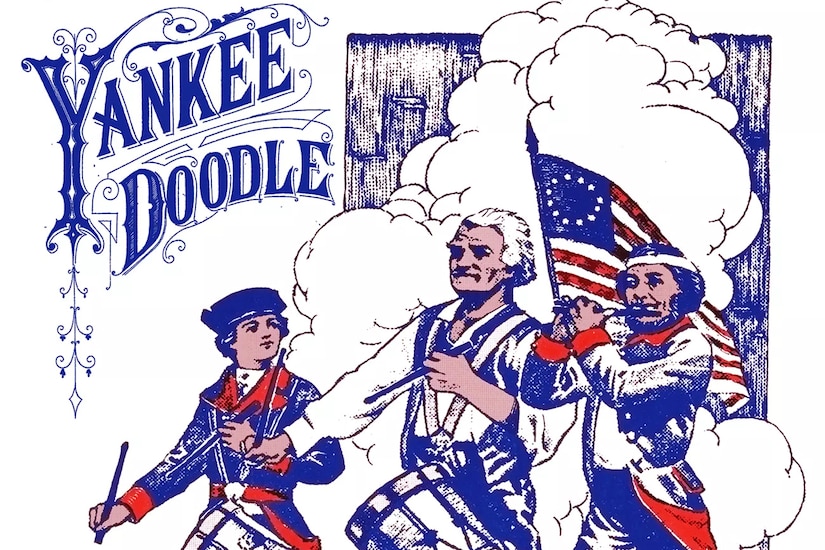
"Yankee Doodle" 

Perhaps the most well-known song still sung today is "Yankee Doodle." It was originally sung by British military officers to mock the American service members they served with during the French and Indian War.

Written by British Army surgeon Richard Shuckburgh while campaigning in New York, circa 1755, the song was embraced by American troops, who added verses to it that mocked the British and hailed their commander, Continental Army Gen. George Washington. By 1781, "Yankee Doodle" had become a song of national pride among Americans.  

The song begins with/Yankee Doodle went to town/A-riding on a pony/Stuck a feather in his cap/And called it macaroni. 

The term macaroni was used to describe a fashionable man who dressed and spoke in an outlandishly affected and effeminate manner.

The American version was written in 1776 by Edward Bangs, a Minuteman, and was played during the British surrender following the Battle of Saratoga, Oct. 17, 1777, in New York.

"Yankee Doodle" was revived by George M. Cohan to create the patriotic song, "The Yankee Doodle Boy" for his 1904 Broadway musical "Little Johnny Jones." In 1942, the movie "Yankee Doodle Dandy," about the life of Cohan, starred James Cagney, for which he won an Oscar.

The song "Yankee Doodle" was adopted as Connecticut's official state anthem in 1978. 

"Chester" 

The unofficial anthem of the American cause, William Billings' "Chester," was immensely popular during the war. It encouraged the patriots to be strong, because God was standing on their side against the British tyrants, which is heard in these lyrics: 

When God inspir'd us for the fight/ Their ranks were broke, their lines were forc'd/ Their ships were shatter'd in our sight/ Or swiftly driven from our coast. 

Billings, a Boston native, was America's first choral composer. Chester is an old Latin word for military camp. The song was the first truly patriotic song with both the tune and lyrics written by an American in the American colonies. 

"Liberty Song" 

The "Liberty Song" was an early American patriotic ballad composed by John Dickinson, a founding father. It is often attributed as the origin of the phrase: "United We Stand, Divided We Fall."  

The song was one of the first to circulate within the 13 colonies and is thought to have fostered a sense of shared identity and resistance among the colonists. It includes the following lyrics: 

Then join hand in hand, brave Americans all/ By uniting we stand, by dividing we fall/ In so righteous a cause let us hope to succeed/ For heaven approves of each generous deed. 

The 1969 song, "United We Stand" by Brotherhood of Men, was a romantic ballad that took some inspiration from "Liberty Song" with the lyric, "united we stand, divided we fall." Despite the romantic connotations, the song became a rallying cry for the Vietnam War based on these lyrics:  

For united we stand, divided we fall/ And if our backs should ever be against the wall/ We'll be together, together, you and I. 

"Free America" 

Joseph Warren, a member of the Sons of Liberty, wrote "Free America" to the tune of "The British Grenadiers," inspiring many colonists to volunteer for the cause of freedom during the Revolutionary War with the following words:  

Torn from a world of tyrants/ Beneath this western sky/ We formed a new dominion/ A land of liberty/ The world shall own we're freemen here/ And such will ever be/ Huzza, huzza, huzza/ For love and liberty. 

"The World Turned Upside Down" 

The song "The World Turned Upside Down" is a 17th-century British ballad written to protest the Puritan banning of traditional Christmas celebrations. It is thought to have been played by the British Army band when they surrendered after the Siege of Yorktown in 1781, though there is no historical evidence that it actually happened. The lyrics include the following:  

Listen to me and you shall hear, news hath not been this thousand year/Since Herod, Caesar, and many more, you never heard the like before/Holy-dayes are despis'd, new fashions are devis'd/Old Christmas is kickt out of Town/Yet let's be content, and the times lament, you see the world turn'd upside down. 

If the song title seems familiar, it is because the words gained new popularity more than 300 years after they were first written, when Lin-Manuel Miranda wrote his 2015 Broadway musical, Hamilton. 

Near the end of the first act, "Yorktown (The World Turned Upside Down)" recaps the historic Battle of Yorktown: 

We negotiate the terms of surrender/I see George Washington smile/We escort their men out of Yorktown/They stagger home single file/Tens of thousands of people flood the streets/There are screams and church bells ringing/And as our fallen foes retreat/I hear the drinking song they're singing/The world turned upside down.

Right


ABOUT   NEWS   HELP CENTER   PRESS PRODUCTS
Facebook   X   Instagram   Youtube

Unsubscribe | Contact Us


This email was sent to sajanram1986.channel@blogger.com using GovDelivery Communications Cloud on behalf of: U.S. Department of War
1400 Defense Pentagon Washington, DC 20301-1400

No comments:

Post a Comment