


Thursday, April 30, 2026

Reauthorizations Accelerate Tech for War Department

Left
U.S. War Department: News
Reauthorizations Accelerate Tech for War Department
April 29, 2026 |  By C. Todd Lopez

The recent reauthorization of a couple of small business technology programs opens the gates for the War Department to get cutting-edge technology more quickly into the hands of warfighters. 

The Small Business Innovation Research and Small Business Technology Transfer programs have, for decades, been cornerstones of defense innovation by allocating billions of dollars in research and development awards to thousands of American small business innovators. 

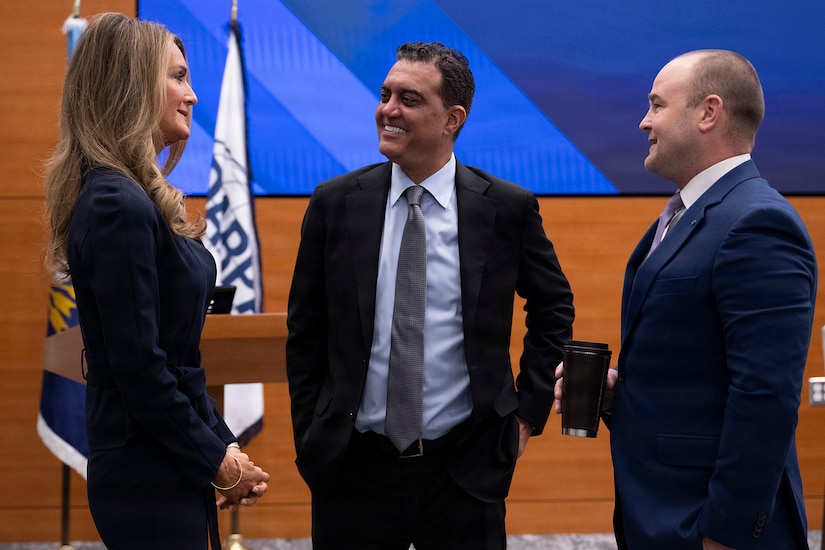
At the Defense Advanced Research Projects Agency headquarters in Arlington, Virginia, today, Emil Michael, undersecretary of war for research and engineering, explained how the Small Business Innovation and Economic Security Act, signed into law April 13 by President Donald J. Trump, enhances the department's access to the best technology. 

"The moment the bill was signed, we had solicitations ready, including over 90 topics where the department seeks innovative capabilities directly from industry," Michael said, adding that, since its inception, the all-time investment through those programs stands at over $41 billion.  

"That funding has driven 80,000 awards to 14,000 small businesses. This is how we turn American ingenuity into an overwhelming battlefield advantage for the warfighter," he said. 

The greatest innovation happens in small businesses, and Michael said American small businesses doing innovative work in space, artificial intelligence, hypersonic research and quantum, for instance, will ensure U.S. warfighters can confidently face the emerging threats from adversaries.

"Our small business partners bring the grit, the speed, [and] the agility that the joint force needs to win," he said. "Moving forward, every innovation dollar we invest, including through SBIR [and] STTR, must deliver bleeding-edge capability to our military that can scale rapidly and remain cost-effective for the American taxpayer." 

Michael said that as the head of the War Department's technology office, he plans to make it easier for small businesses to partner with the government to bring their innovation and to eliminate bureaucracy. 

"Under my leadership, we're done stringing industry along with endless 'maybes,'" he said. "My commitment to you is fast 'yeses' and fast 'nos,' so you can get back to doing what you do best: innovating for the warfighter." 

Kelly Loeffler, administrator of the Small Business Administration, said the War Department's investment in small businesses has huge economic impacts inside the U.S. 

"[For] the Department of War alone, [each] dollar they invest has a 22-to-one return on investment, which is really powerful," she said. "It's generated about $121 billion in revenues and 1.5 million jobs in this country."

Loeffler said nearly half of the awards go to firms with fewer than 25 employees, noting that America's small innovators, on which the program was founded, are making the largest strategic impact on national security. 

Small businesses are already contributing to the War Department's efforts through SIBR and STTR funding. 

Weather-sensing hardware and software developed by PEMDAS Technologies & Innovations can be used on helicopters and autonomous aircraft like drones, for instance, to equip them to be more aware of weather hazards, even outside the U.S. Using SBIR dollars, Caroline Harten, a meteorologist with PEMDAS, said the company was able to develop prototypes, flight test prototypes and provide opportunities to collaborate with the Defense Advanced Research Projects Agency. 

"We're working to solve a very hard problem that's critical to our ability to operate overseas," she said.  

Small Business Innovation Research funding allows the company to keep working and developing prototypes for DOW. 

Thibault Roumengous, director of research at NIRSense, said SBIR dollars are enabling biosensors developed by his company "to look at collaboration and engagement of ... drone pilots in special training circumstances." 

Using near-infrared spectroscopy, he said, the sensors measure perfusion, which is the delivery of blood to tissue. Such systems allow monitoring of reperfusion injuries from tourniquets, for instance. 

The company put sensors on headgear, adding EEG and the ability to supply bio-impedance pulses to help improve performance by increasing alertness. "It stimulates the brain to keep the user engaged," Roumengous said. "But it's still about monitoring somebody's physiology."

Right


ABOUT   NEWS   HELP CENTER   PRESS PRODUCTS
Facebook   X   Instagram   Youtube

Unsubscribe | Contact Us


This email was sent to sajanram1986.channel@blogger.com using GovDelivery Communications Cloud on behalf of: U.S. Department of War
1400 Defense Pentagon Washington, DC 20301-1400

No comments:

Post a Comment

DOW Featured Photos

...