


Friday, March 20, 2026

Innovation in Action: Airman-Built 3D Model Strengthens Air Traffic Controller Training

Left
U.S. War Department: News
Innovation in Action: Airman-Built 3D Model Strengthens Air Traffic Controller Training
March 20, 2026 |  By Air Force Senior Airman Imani West

Airmen assigned to the 19th Operations Support Squadron at Little Rock Air Force Base, Arkansas, are taking a creative approach to training the next generation of air traffic controllers by developing a detailed 3D model that visually represents aircraft patterns and procedures used at the installation.


The innovation demonstrates how airmen are leveraging emerging technologies and creative problem-solving to improve training and operational readiness. 
 
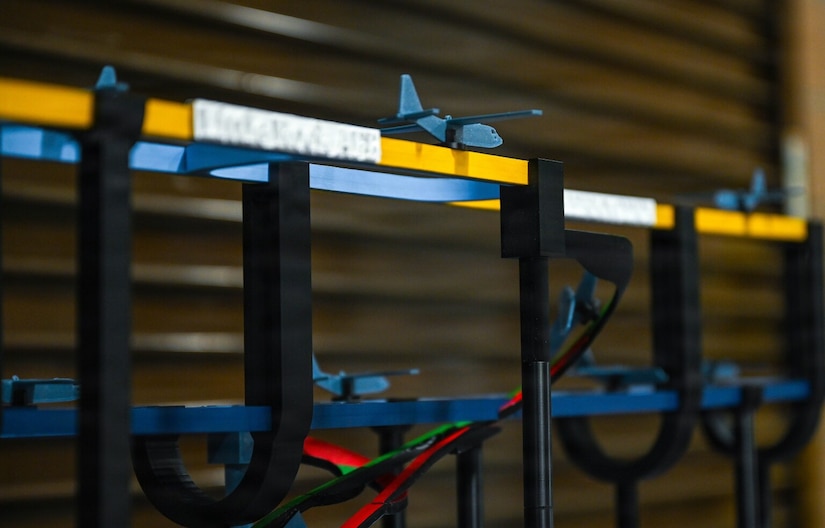
The immersive training tool was designed and produced by Air Force Airman Jay Perry, 19th OSS air traffic control apprentice. It provides a scale representation of the base's airspace and flight patterns. The project was inspired by an idea from Air Force Tech. Sgt. Ryan Sanders, 19th OSS noncommissioned officer in charge of training and standardization. 
 
Traditional training methods often rely on instructors holding model aircraft or cards to demonstrate aircraft positions and movements. While effective, the approach can make it difficult for visual and tactile learners to fully imagine spacing, conflict points and maneuvering patterns.


"This model allows us to physically show where aircraft may break in the pattern, extend downwind or maneuver differently," Sanders said. "It helps airmen understand when conflict may exist or when it doesn't, based on the flight path." 
 
The model re-creates the installation's airspace layout at scale and uses magnets to hold miniature aircraft in place, allowing instructors to demonstrate real-world scenarios more accurately. The enhanced visualization helps trainees better understand aircraft spacing, sequencing and potential conflict areas. 
 
Perry used a 3D modeling program to build his creation, but he made it by manipulating shapes to create detailed designs. After designing each component digitally, Perry prepared the parts for printing and produced them using multiple 3D printers available at the base innovation lab.


The process required careful planning, preparation and experimentation. 
 
"Everything started from a single block in the design software," Perry said. "Each piece had to be separated and designed in a way that it could be printed and assembled later. It might look simple when you see the final model, but a lot of thought went into making sure the supports, slopes and connections would actually work." 
 
One of the biggest challenges was ensuring the model could support its own structure at the scale required to accurately represent the airfield. The team experimented with different stand designs and angles to create a realistic yet durable layout.


By transforming abstract training concepts into a physical, visual model, the 19th Operations Support Squadron is helping trainees better grasp the complexities of airfield operations. This ensures controllers are better equipped to manage the skies above the base. 
 
The project also highlights a broader culture of innovation across the installation, where airmen at every level are encouraged to identify challenges and develop solutions that enhance mission effectiveness.

Right


ABOUT   NEWS   HELP CENTER   PRESS PRODUCTS
Facebook   X   Instagram   Youtube

Unsubscribe | Contact Us


This email was sent to sajanram1986.channel@blogger.com using GovDelivery Communications Cloud on behalf of: U.S. Department of War
1400 Defense Pentagon Washington, DC 20301-1400

No comments:

Post a Comment