


Friday, February 20, 2026

Battle of Yorktown Leads to Treaty With Great Britain

Left
U.S. Department of War: Feature
Battle of Yorktown Leads to Treaty With Great Britain
Feb. 20, 2026 | By David Vergun

This year marks the nation's 250th birthday, celebrating the Declaration of Independence.

To attain independence, the Americans would have to win the Revolutionary War against Great Britain, which previously governed the 13 colonies. The war lasted from April 19, 1775, to Sept. 3, 1783. 

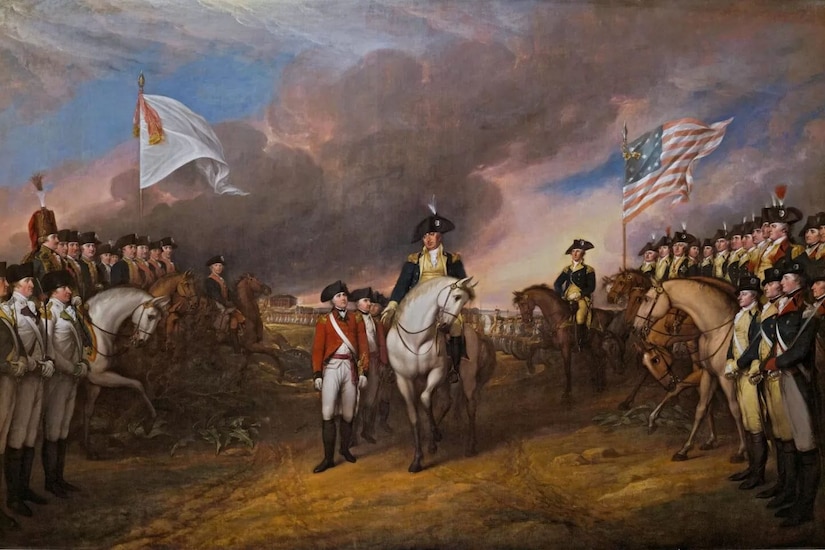
The final decisive battle of the war took place in the vicinity of Yorktown, Virginia, from Sept. 28 to Oct. 19, 1781. 

The victory persuaded King George III and the government of Great Britain to begin negotiations to end the war, resulting in the 1783 Treaty of Paris, which formally acknowledged the independence of the United States. 

The Siege of Yorktown, as it is sometimes called, pitted the British army, led by Gen. Charles Cornwallis, and the British navy, led by Adm. Thomas Graves, against the Continental Army, led by Gen. George Washington, and the French navy, led by Adm. Francois Joseph Paul de Grasse and the French army, led by Lt. Gen. Jean-Baptiste-Donatien de Vimeur, Comte de Rochambeau.

The total land and naval forces of Great Britain were about 8,000 personnel, and the combined American and French land and naval forces numbered about the same. 

Washington's Continental Army, aided by French land and naval forces, surrounded the British army, compelling the surrender of Cornwallis and his entire force. 

Interesting facts:

  • Marquis de Lafayette, a French major general, was so passionate about the American cause that he was given senior positions in the Continental Army and commanded Americans at Yorktown. The most famous quote when American troops arrived in France during World War I in 1917 was: "Lafayette, we are here!" Lafayette Square in Washington is named for him, and there's also a statue of him there. 
  • In a strange twist of fate, after Yorktown, de Grasse returned with his fleet to the Caribbean, where a British fleet under Adm. George Rodney defeated and captured de Grasse at the Battle of the Saintes. De Grasse was widely criticized for his defeat, ending his naval service. Cornwallis later had a successful career as a civil and military governor in Ireland and then in India. 
  • Yorktown was the site of a second battle during the Civil War, also called the Siege of Yorktown, fought from April 5 to May 4, 1862, with neither Federal nor Confederate forces achieving a victory.

  • Today, the site of the Yorktown battlefield is part of the Colonial National Historical Park, administered by the National Park Service. Nearby is the state-operated American Revolution Museum. Also in Yorktown is the Coast Guard Training Center.
  • The Navy's first USS Yorktown was a sloop-of-war, launched in 1839 and wrecked on an uncharted reef off Maio, Cape Verde in 1850. Although the ship was lost, no lives were. The second was a gunboat, launched in 1888 and decommissioned in 1919. The third was an aircraft carrier, launched in 1936 and sunk as a result of extensive damage sustained at the 1942 battle of Midway. The fourth was also an aircraft carrier, launched in 1943 and decommissioned in 1970. The fifth was a cruiser, launched in 1983 and decommissioned in 2004. 
  • The Battle of Yorktown led to the 1783 Treaty of Paris. The French capital was also the site of the Jan. 27, 1973, Vietnam Peace Agreement, ending the fighting.
Right


ABOUT   NEWS   HELP CENTER   PRESS PRODUCTS
Facebook   X   Instagram   Youtube

Unsubscribe | Contact Us


This email was sent to sajanram1986.channel@blogger.com using GovDelivery Communications Cloud on behalf of: U.S. Department of War
1400 Defense Pentagon Washington, DC 20301-1400

No comments:

Post a Comment

Department of War Invests $11.8M for the Domestic Processing of Critical Materials

View Online IMMEDIATE RELEASE ...