


Friday, January 16, 2026

Military Played Role in 1876 Centennial Celebrations

Left
U.S. Department of War: Feature
Military Played Role in 1876 Centennial Celebrations
Jan. 16, 2026 | By David Vergun


Every 50 years, the United States holds milestone Independence Day celebrations. This year marks the nation's 250th birthday and fifth semicentennial celebration. 

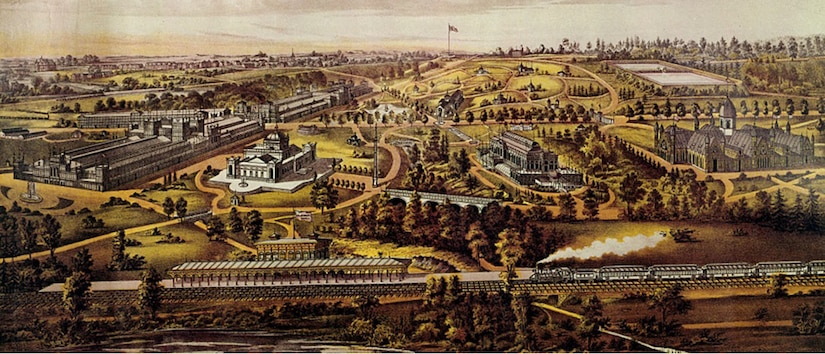
The nation's centennial was celebrated July 4, 1876, in Philadelphia with the sprawling Centennial Exposition, the first world's fair in the United States, which lasted from May 10 to Nov. 10.


While the exposition focused on advances in industry, agriculture, consumer goods, communication, transportation and the arts, the military provided its own significant displays. 

The exhibitions were "an opportunity to show an old-fashioned patriotism … in bringing together our brothers who were our most terrible enemies a few years ago," said Joseph R. Hawley, the exposition president and Union brevet major general during the Civil War.


The Army had a large exhibit that showcased its advances in health and medicine that benefited service members as well as civilians.

The Army Medical Museum, precursor to the National Museum of Health and Medicine, featured exhibits including a replica of a 24-bed military hospital and pitched hospital tents. It also exhibited different modes of transport including stretchers, litters and medical wagons as well as surgical instruments.


Many doctors who sought insights into advances in medical technology, including disease prevention, sanitation and research, visited the exhibit. 

Not to be outdone, the Navy had a sprawling exhibit that featured astronomical equipment, vessels on the adjacent Schuylkill River, ordnance, armament, rigging, models of dry docks, ship steam engines and boilers.


President Ulysses S. Grant officially opened the exposition. Before becoming president, he led Union forces during the Civil War and continued in that capacity after the war as general of the Army until 1869. He was also the acting secretary of war from 1867 to 1868. 

Alphonso Taft was secretary of war in 1876, and William Tecumseh Sherman, a former Union major general during the Civil War, was general of the Army.


Although the Civil War had ended over a decade earlier, troops in 1876 were still engaged in combat. 

The Great Sioux War of 1876 was taking place between the Army and an alliance of Plains Native Americans, stretching from Nebraska to Montana.  

The war is best known for the Battle of the Little Bighorn in the Montana Territory, June 25 to 26, 1876, during which Army Lt. Col. George Armstrong Custer and his 700 men of the 7th Cavalry Regiment suffered a significant defeat.


The war ended in 1877, with the loss of Native American territory and establishment of reservations. 

Elsewhere, soldiers were still occupying former Confederate states, as part of post-Civil War Reconstruction. By 1877, Reconstruction ended and the occupying forces withdrew. 

George M. Robeson was secretary of the Navy in 1876. The position of chief of naval operations did not yet exist. Navy Adm. David Dixon Porter was the highest-ranking officer. Marine Corps Brig. Gen. Jacob Zeilin was the Corps' commandant until Oct. 31, 1876. He was followed by Marine Corps Col. Charles G. McCawley, who served in that position for the next 14 years.


On May 18, 1876, Marines were sent to police the town of Matamoros, Mexico, temporarily to protect American citizens and property as security had been degraded. 

Most of the Navy's ships were still propelled by sail in 1876, but the transition to steam was already underway. Sailors and Marines aboard these vessels traveled globally to display the flag, protect commerce and participate in scientific exploration.

Right


ABOUT   NEWS   HELP CENTER   PRESS PRODUCTS
Facebook   X   Instagram   Youtube

Unsubscribe | Contact Us


This email was sent to sajanram1986.channel@blogger.com using GovDelivery Communications Cloud on behalf of: U.S. Department of War
1400 Defense Pentagon Washington, DC 20301-1400

No comments:

Post a Comment