


Wednesday, December 3, 2025

Air Force Celebrates 75 Years of Honor Guard Drill Team Excellence

Left
U.S. War Department: News
Air Force Celebrates 75 Years of Honor Guard Drill Team Excellence
Dec. 3, 2025 |  By Airman Shanel Toussaint, Joint Base Anacostia-Bolling

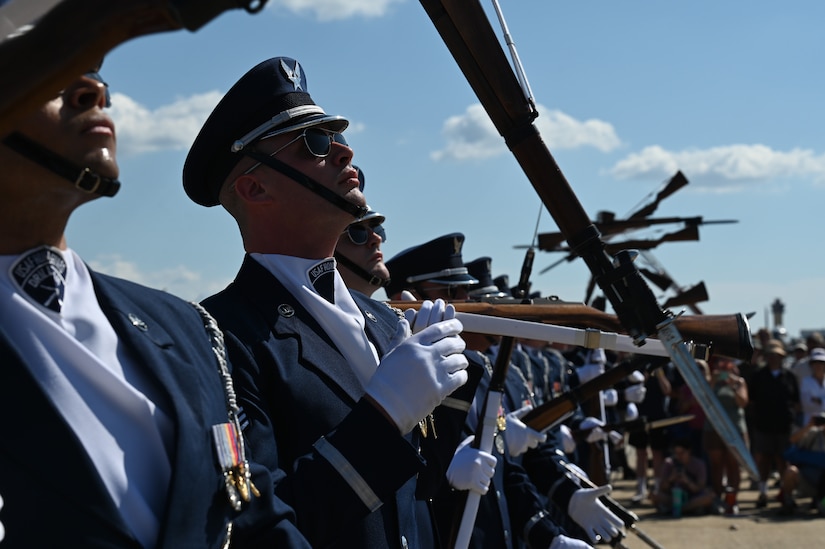
For 75 years, the U.S. Air Force Honor Guard Drill Team has represented the discipline, precision and professionalism of the service to audiences around the world. 
 
Founded in 1950 to perform ceremonial honors in the National Capital Region, today the drill team operates from Joint Base Anacostia-Bolling, Washington, and performs more than 100 exhibitions each year across the globe. 
 
The team's legacy of precision has been built by seven and a half decades of airmen who refined every crisp movement to reflect the Air Force's commitment to excellence.

"We have been the living embodiment of that commitment," said Air Force Capt. Andrew Paquin, honor guard flight commander of ceremonial operations. "The core theme has been the same since the beginning. It's the relentless pursuit of perfection." 
 
Each member trains full time to master the team's seven-minute routine. Behind every public performance are thousands of hours of repetition and technical correction. 
 
"We break down every movement into its smallest components until the sequence becomes muscle memory," Paquin said. 
 
That dedication to excellence was evident during the 2025 Royal Edinburgh Military Tattoo in Scotland, where the team performed alongside international partners during driving rain and heavy winds. 
 
"Seeing the team perform in those conditions was a reminder of their resilience and ability to adapt and push through discomfort," Paquin said. "Being there on the ground with them created a bond built on mutual trust." 
 
That standard of excellence extends to mentorship and development within the team.  
 
"The main mission is to honor the individuals being buried at Arlington ," said Air Force Senior Airman Richard Miles, honor guard drill team trainer. "Drill is the traveling component of that mission, the part that connects the public to who we are and what we represent." 
 
Miles wanted to join the unit after seeing a drill team performance during his time in Air Force technical training. After he was accepted, he spent more than a year working to become a trainer. 

"I failed my first evaluation," he said. "I passed my second and from then on spent a lot of extra hours practicing by myself after group training ended." 
 
The extra hours he spent training paid off when he earned the position of drill team trainer and that perseverance now guides how he trains others. 
 
"We have a big-brother, big-sister program, where experienced drillers mentor new members," Miles said. "As a trainer, the best part is seeing people accomplish what they once thought they couldn't. It's about being a hands-on leader who sets the tone for excellence." 
 
The perfection that audiences see during drill team performances directly reflects the accountability and trust built in training. 
 
"We train to perform under fatigue, stress and pressure, because that's where excellence becomes habit," Paquin said. 
 
That high standard is recognized by symbols on each member's white ascot; the most advanced level of competency is represented by two stars. 
 
"The stars represent the best of the best," Miles said. "You can't earn them through just drills. You have to be the airman that leadership knows they can rely on, no matter what." 
 
While the uniforms, movements and routines have undergone changes during the 75-year history, the mission to represent the Air Force with honor remains steadfast. 

"When the team arrives at a performance, they're impressive, but the real magic happens afterward with the crowd interaction," Paquin said. "People see that the airmen behind the uniforms are young men and women from towns just like theirs. That's what builds trust with the American public." 
 
In an age of rapidly evolving technology, the human element is what continues to keep the drill team relevant. As the team looks ahead to its next major milestone, a centennial in 2050, Paquin said the focus will stay the same. 
 
"The Air Force Honor Guard Drill Team is needed now more than ever," he said. "It humanizes the Air Force mission, builds trust with the American public, and inspires future generations." 

Right


ABOUT   NEWS   HELP CENTER   PRESS PRODUCTS
Facebook   X   Instagram   Youtube

Unsubscribe | Contact Us


This email was sent to sajanram1986.channel@blogger.com using GovDelivery Communications Cloud on behalf of: U.S. Department of War
1400 Defense Pentagon Washington, DC 20301-1400

No comments:

Post a Comment

Week in Review

...