Saturday, May 9, 2026

American Revolutionary War Flags Flown to Inspire Patriotism

Left
U.S. Department of War: Feature
American Revolutionary War Flags Flown to Inspire Patriotism
May 8, 2026 | By David Vergun


The American flag is a symbol of freedom and patriotism, but before the Continental Congress adopted the first official flag in 1777, many other flags were flown.  

As America celebrates 250 years of freedom, here's a look at a few of the various United States flags flown during combat by soldiers, sailors, Marines and militia during the American Revolutionary War.  

Flags were a significant part of the war, as they served to instill esprit de corps in the men and also aided in rallying the troops, as the flag carrier led from the front. They expressed liberty and national identity, as well as a means to assert sovereignty against British rule.  

The use of colors — the term for the banners and flags — dates back to the Middle Ages in Europe, when knights displayed their distinctive symbols and colors on their shields to identify one another on the battlefield. The ancient Romans and Greeks also carried banners with symbols of their leaders into battle.  

Today, the American flag, also known as the Stars and Stripes and Old Glory, serves to unite the nation and inspire patriotism. Although military units have their own colors, all fly the American flag higher, giving it the most prominent position.  

The Hopkinson flag 


Most historians agree that Francis Hopkinson was the designer of the first official American flag. On June 14, 1777, the Second Continental Congress adopted the Hopkinson flag, calling it the Stars and Stripes.  

Since there were only 13 states then, the design featured 13 stripes and 13 six-pointed stars arranged in rows on the field of blue. He also designed a very similar flag for the Navy, which looks similar to today's flag because the red stripes are located at the top and bottom. 

The Hopkinson flag was first carried into combat during the Battle of Brandywine, Sept. 11, 1777, just outside Philadelphia. 

Hopkinson also helped design the Great Seal of the United States and was a signer of the Declaration of Independence; many consider him a Founding Father. 

The Serapis flag 


Featuring 13 blue, red and white stripes and 13 stars, the Serapis flag design is similar to the Hopkinson flag except for the arrangement of stars and the blue stripes. 

The flag has an unusual origin story: it was named for the Royal Navy frigate HMS Serapis. 

The Serapis engaged the American warship USS Bonhomme Richard under the command of Continental Navy Capt. John Paul Jones in the North Sea near England on Sept. 23, 1779. 

The battle resulted in the capture of the Serapis. Jones' ship was badly damaged and sank, so he sailed the Serapis to the neutral Dutch port of Texel without a flag — technically making him a pirate. 

Benjamin Franklin, then an ambassador to France, was asked to provide a flag that Jones could use. Once created, the flag diffused the diplomatic tension, and Jones was released by the Dutch. 

The Serapis flag was one of the first flags of the United States, although it was never used in an official capacity. However, it is strongly associated with Jones and his heroics as one of the great captains of the Continental Navy and his contributions to the war effort. 

The flag is used to this day on the USS John Paul Jones, a missile destroyer commissioned in 1991 to honor the famous captain. It is sometimes called the Franklin flag in honor of the Founding Father who helped create it. 

The Grand Union flag 


Also known as the Congress flag, the Cambridge flag and the Continental Union flag, the Grand Union flag is the first national flag of the United States; it was flown from 1775 to 1776. 

The Grand Union flag consisted of 13 red and white stripes with the British Union Jack located in the area now occupied by stars. The flag was first flown by Continental Navy Lt. John Paul Jones on Dec. 3, 1775, on the USS Alfred. 

The Betsy Ross flag 


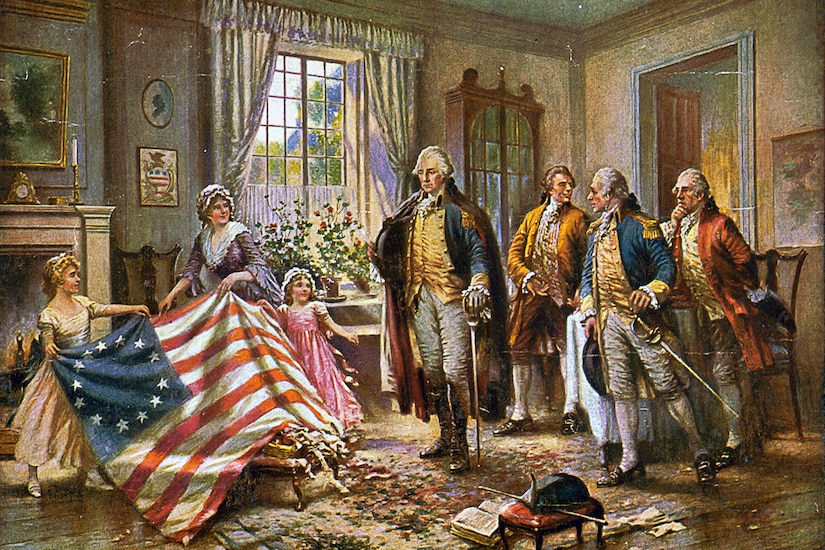
Betsy Ross was a professional upholsterer in Philadelphia from the early 1770s until she retired in 1827. While there is no historical evidence, many people believe she designed the American flag. During and after the war, Ross made a variety of military flags over the course of 50 years.   

The Betsy Ross flag is similar to the other flags in that it has 13 stripes and 13 stars on a field of blue, but rather than rows, her design includes five-pointed stars arranged in a circle.

Right


ABOUT   NEWS   HELP CENTER   PRESS PRODUCTS
Facebook   X   Instagram   Youtube

Unsubscribe | Contact Us


This email was sent to sajanram1986.channel@blogger.com using GovDelivery Communications Cloud on behalf of: U.S. Department of War
1400 Defense Pentagon Washington, DC 20301-1400

Today in DOW: May 9, 2026

Left
Department of War: Today in DOW
Today in DOW: May 9, 2026
Open Press Events
Secretary of War
Secretary of War

The secretary has no public or media events on his schedule.   Read More >

Deputy Secretary of War

The deputy secretary has no public or media events on his schedule.   Read More >

Chairman, Joint Chiefs of Staff

The chairman has no public or media events on his schedule.   Read More >

Vice Chairman, Joint Chiefs of Staff

The vice chairman has no public or media events on his schedule.   Read More >

Additional Open Press Events


Contacts

Additions and corrections for Today in DOW are invited and should be directed to the press desk by calling +1 (703) 697-5131 or +1 (703) 697-5132. For additional media information click here.

Public Inquiries

Contact us for more information, if you have questions or for technical support.

Media Questions

News media representatives with questions for the Department of War may reach our press desk by calling +1 (703) 697-5131.

Duty Officer

A public affairs duty officer is available 24 hours a day through +1 (703) 697-5131.

Right

Press Advisories   Releases   Transcripts

Speeches   Publications   Contracts


ABOUT   NEWS   HELP CENTER   PRESS PRODUCTS
Facebook   X   Instagram   Youtube

Unsubscribe | Contact Us


This email was sent to sajanram1986.channel@blogger.com using GovDelivery Communications Cloud on behalf of: U.S. Department of War
1400 Defense Pentagon Washington, DC 20301-1400

DOW Featured Photos

Left
U.S. Department of War: Photos
Legacy Flight
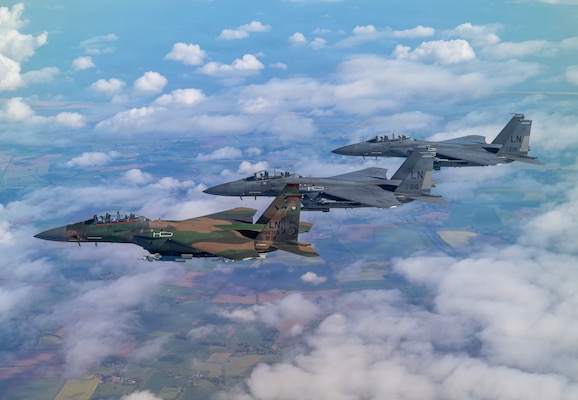
F-15E Strike Eagle aircraft assigned to the 494th Fighter Squadron fly in formation above the United... Photo Details >
In the Thicket
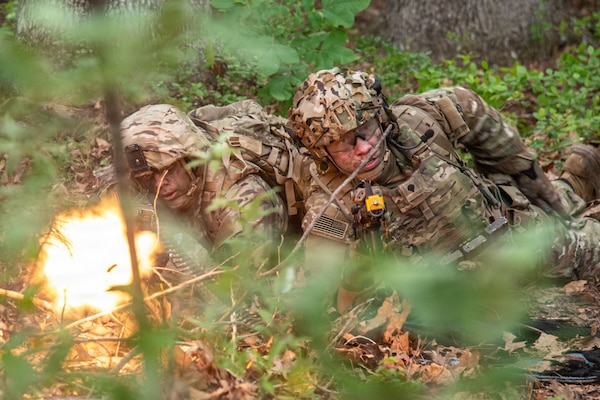
Soldiers take part in an emergency deployment readiness exercise at Fort A.P. Hill, Va., May 6, 2026... Photo Details >
Out of the Box
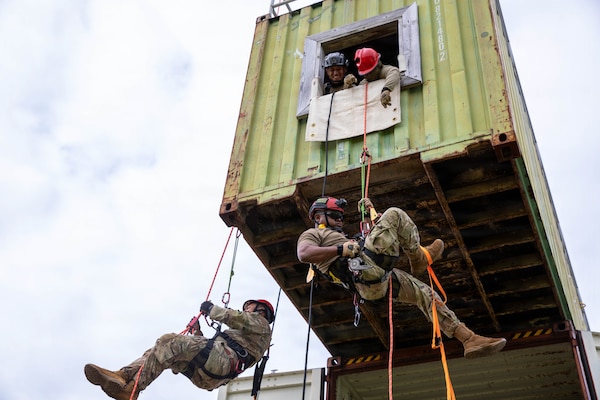
Hawaii National Guard soldiers and airmen ascend ropes toward a storage container during a collectiv... Photo Details >
Out for Delivery
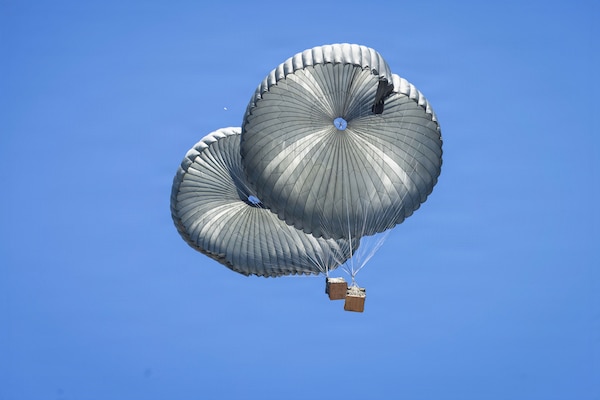
A Marine Corps KC-130J Super Hercules aircraft, not pictured, drops resupply crates during an air de... Photo Details >
Pier Pressure
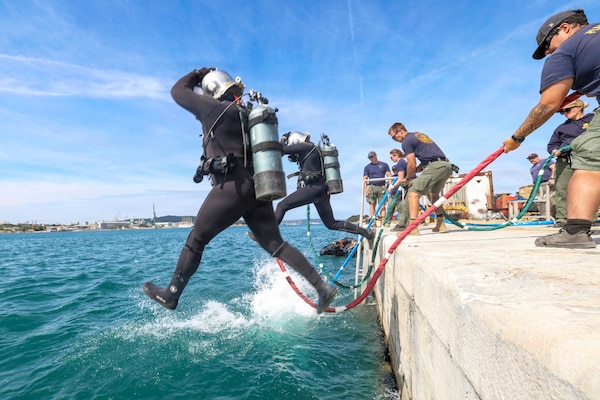
Navy Seabee divers prepare to conduct infrastructure repairs and assessments at the Port Brizine fue... Photo Details >
Keeping Watch
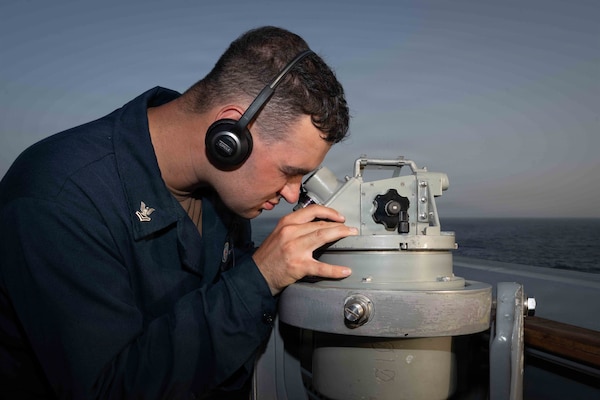
A sailor uses a telescopic alidade aboard the guided-missile destroyer USS Pinckney, May 4, 2026. Photo Details >
Island Hopping
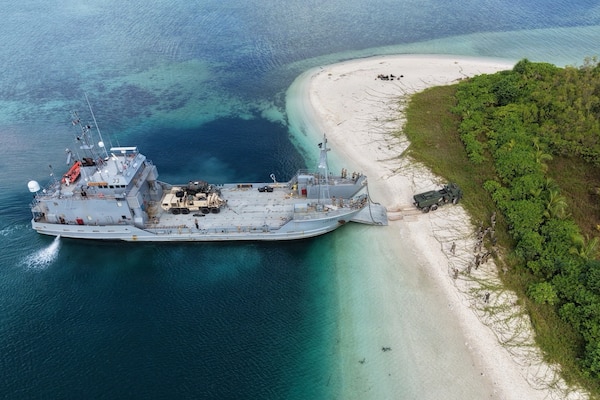
An Army M142 High Mobility Artillery Rocket System moves onto land from a vessel during maritime key... Photo Details >


Right


ABOUT   NEWS   HELP CENTER   PRESS PRODUCTS
Facebook   X   Instagram   Youtube

Unsubscribe | Contact Us


This email was sent to sajanram1986.channel@blogger.com using GovDelivery Communications Cloud on behalf of: U.S. Department of War
1400 Defense Pentagon Washington, DC 20301-1400

Forging Tactical Readiness During Iron Ascent

Left
U.S. War Department: News
Forging Tactical Readiness During Iron Ascent
May 8, 2026 |  By Air Force Tech. Sgt. Heather Ley, 92nd Air Refueling Wing

In a deliberate push to build a more agile and combat-ready force, the 92nd Air Refueling Wing launched Iron Ascent, a rigorous three-day tactical training course, held at Fairchild Air Force Base, Washington, April 29-May 1.

The inaugural program pulled airmen out of their typical daily duties and into hands-on combat environments, enabling training participants from various career fields to operate as capable expeditionary warfighters. The initiative was spearheaded by Air Force Chief Master Sgt. Lindsay Moon, 92nd ARW command chief, who saw a need to provide airmen with training beyond computer-based modules and classroom instruction. 

"Iron Ascent is a course that we locally created, realizing there was a need to get past the things we learn by [computer] or in a classroom, and trying to get folks out into the field and really recognizing what [the] warrior ethos is," Moon said. "It allowed us to drop people out into the field to do combat-related operations, even if it's not the same thing we expect them to do day to day." 

The result was a rigorous, multifaceted training experience. The first day was dedicated to academics, where participants received briefings on essential deployment skills. 

"The classroom instruction covered deployment tactics, explosive ordnance disposal capabilities and tactical combat casualty care," said Air Force Tech. Sgt. Katlynn Bell, the noncommissioned officer in charge of training for the 92nd Security Forces Squadron, who also served as part of the exercise cadre. "It was mainly learning the fundamentals, so it's easier for the practical portions later on." 

During day two, the airmen split into two groups to apply their new knowledge, swapping halfway through the day so everyone completed both events. One group practiced close-quarters battle tactics and troop movements at the security forces' "shoot house," and the other group rappelled down a 30-foot wall with survival, evasion, resistance and escape specialists. 

"We tried to progressively build on the concepts," Moon said. "We were able to hand them actual M4 [assault rifles] so they could practice clearing rooms, being in formation and communicating together."

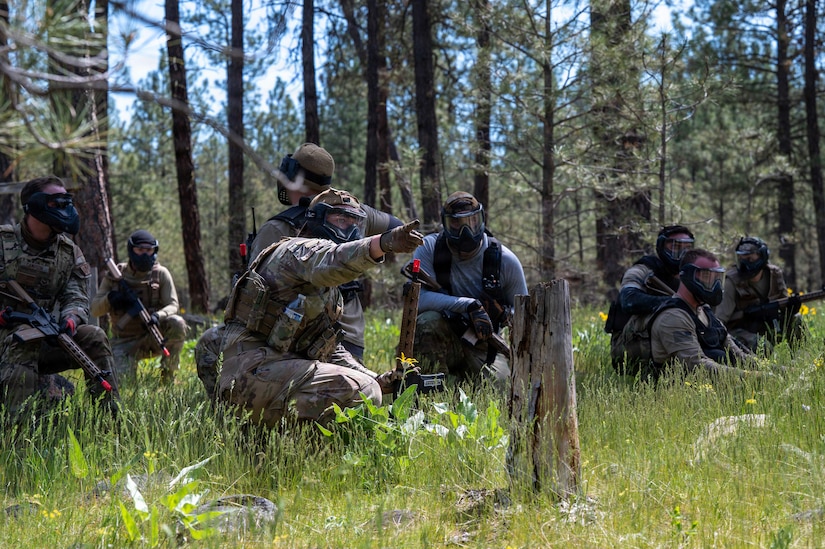
The final day culminated in a field training exercise at Nighthawk Range, where participants faced a series of challenging scenarios across 50 acres of terrain. They defended locations, acquired intelligence and navigated through ambushes against opposing forces, putting all their training to the test under high-stress conditions. 

"You saw a lot of different stressors that were applied to them, and it was amazing to watch them face those [stressors]," Moon said. 

The exercise reflected the Air Force's broader push toward creating a more agile and versatile force. 

"It's important for people to understand that we may ask you to do things outside of what you learned in tech school," Moon said. "But that is OK; you can do hard things. We had airmen from finance and weather training right alongside security forces and survival instructors; watching them all work together was amazing." 

Air Force Staff Sgt. Dakota Peterson, noncommissioned officer in charge of physical security for the squadron, who also served as part of the exercise cadre, noted the training established a critical baseline for airmen who may find themselves in unexpected roles during a deployment. 

"It's critical because when they deploy, they might be asked to step outside their normal duties, and this training provides that foundation," Peterson said. "It's a stepping stone that allows them to say, 'Hey, I have some experience. I trained for this a year ago, and now I can apply it here.'" 

For the cadre, one of the most rewarding aspects was watching the volunteer participants embrace the challenges head-on. 

"It was really awesome to see people stepping out of their comfort zones, and not being afraid of it, and really just embracing it," Bell said. "It's all volunteers here; no one here was told to be here." 

The enthusiasm was palpable. According to Moon, many participants immediately asked how they could be involved in the next iteration, a testament to the program's success and the growing appetite for hands-on, tactical training.

Right


ABOUT   NEWS   HELP CENTER   PRESS PRODUCTS
Facebook   X   Instagram   Youtube

Unsubscribe | Contact Us


This email was sent to sajanram1986.channel@blogger.com using GovDelivery Communications Cloud on behalf of: U.S. Department of War
1400 Defense Pentagon Washington, DC 20301-1400

Today in DOW: July 13, 2026

...