Tuesday, December 23, 2025

The War Department Announces First Round of FY 2026 APFIT Projects, Surpassing $1 Billion Awarded to Small Businesses

Left
U.S. Department of War: Release
View Online
IMMEDIATE RELEASE
The War Department Announces First Round of FY 2026 APFIT Projects, Surpassing $1 Billion Awarded to Small Businesses
Dec. 22, 2025

The War Department today announced the first round of Accelerate the Procurement and Fielding of Innovative Technologies (APFIT) projects selected for Fiscal Year (FY) 2026, marking a historic milestone in advancing defense innovation and small business engagement for the program. With this announcement, APFIT has now awarded more than $1 billion to small businesses and non-traditional defense contractors across the nation, accelerating groundbreaking capabilities, strengthening the U.S. industrial base and enhancing warfighter readiness.

The FY 2026 project slate represents the next wave of innovative technologies rapidly transitioning from development to fielding and initial production. These awards continue to focus on delivering mission-critical capabilities at scale while expanding opportunity for small businesses in every region, including those in traditionally underrepresented and remote states.

"Crossing the billion-dollar threshold underscores APFIT's commitment to America's small business innovators," said Emil Michael, Under Secretary of War for Research and Engineering, "and we are proud to accelerate the delivery of these critical capabilities to our warfighters."

This year's initial selections reflect the growing scale and maturity of the APFIT portfolio, with the average FY 2026 award now exceeding $30 million per project. The program also recorded its highest single award to date at $49.7 million, issued just under APFIT's $50 million maximum statutory cap, demonstrating both the depth of operational need and APFIT's ability to efficiently transition and scale mature technologies.

APFIT remains a cornerstone of War Department's strategy to accelerate innovation and ensure the United States maintains its technological advantage. Additional FY 2026 projects will be announced throughout the fiscal year as they are selected.

The initial round of FY 2026 selections include*:

  • Autonomous Unmanned Ground Vehicle (UGV) for Ground Based Air Defense (GBAD), $20.00 million, U.S. Marine Corps
  • Deployable, Attritable Optical Systems, $22.15 million, U.S. Space Force
  • Domestic High Performance UAS Batteries, $28.00 million, U.S. Navy
  • Gremlin Low-Cost Munition, $35.00 million, U.S. Marine Corps
  • High Frequency Intercept Direction Finding and Exploitation (HIDES), $21.66 million, U.S. Army
  • Kraken 18 Communications Pod, $33.00 million, U.S. Navy
  • Miniaturized Gyroscope for Resilient Navigation, $20.00 million, U.S. Marine Corps
  • Mobile Smart Manufacturing for Airframe Spares, $25.00 million, U.S. Air Force
  • Augmented Maneuver Vehicle for Satellites, $48.50 million, U.S. Space Force
  • Real-Time Command and Control at the Tactical Edge, $49.70 million, U.S. Army
  • Small Uncrewed Maritime Vessels, $24.00 million, U.S. Navy/U.S. Marine Corps
  • Tactical High-Bandwidth, Low-Latency, high-capacity data network, $10.00 million, U.S. Marine Corps
  • Trolling Uncrewed Navigation Assistant (TUNA) Seeker, $35.00 million, U.S. Marine Corps
  • Whaleshark Autonomous Low-Profile Vessel (ALPV), $29.49 million, U.S. Marine Corps

*Does not include classified selections.

Right

Press Advisories   Releases   Transcripts

Speeches   Publications   Contracts


ABOUT   NEWS   HELP CENTER   PRESS PRODUCTS
Facebook  X   Instagram   Youtube

Unsubscribe | Contact Us


This email was sent to sajanram1986.channel@blogger.com using GovDelivery Communications Cloud on behalf of: U.S. Department of War
1400 Defense Pentagon Washington, DC 20301-1400

The Department of War Releases the 2026 Continental U.S. Cost-of-Living Allowance Rates

Left
U.S. Department of War: Release
View Online
IMMEDIATE RELEASE
The Department of War Releases the 2026 Continental U.S. Cost-of-Living Allowance Rates
Dec. 22, 2025

The Department of War released the 2026 Continental United States Cost-of-Living Allowance rates today. These new rates will go into effect Jan. 1, 2026. As a result of the 2026 adjustment, $99 million will be paid to approximately 127,000 uniformed service members stationed within Continental United States next year.

Continental United States Cost-of-Living Allowance is a supplemental allowance provided to service members and designed to help offset higher living expenses in the highest-cost locations in Continental United States. An area is considered high-cost if the non-housing cost of living for that area, inclusive of categories such as transportation and goods and services, exceeds a threshold of 107% of the national average. 

By law, a Continental United States Cost-of-Living Allowance rate is only prescribed when the index meets a certain threshold above the Continental United States average. Service members assigned to duty stations where the non-housing cost of living is at least seven percent above the national average are eligible for Continental United States Cost-of-Living Allowance. Data is adjusted to account for Basic Allowance for Subsistence, which is meant to offset the costs for a service member's meals and cost savings gained from shopping at commissaries and exchanges. 

For 2026, these are the Continental United States Cost-of-Living Allowance changes:

  • Six military housing areas will begin receiving Continental United States Cost-of-Living Allowance; 
  • Eight military housing areas will receive an increase in Continental United States Cost-of-Living Allowance; 
  • Two military housing areas will continue receiving the Continental United States Cost-of-Living Allowance; 
  • Two military housing areas will receive a decrease in Continental United States Cost-of-Living Allowance;
  • Nine military housing areas will no longer receive Continental United States Cost-of-Living Allowance; and
  • 21 counties will lose Continental United States Cost-of-Living Allowance for non-military housing areas in non-metropolitan counties. 

Military housing areas with the highest Continental United States Cost-of-Living Allowance rates:

  • San Francisco, California        8%
  • Oakland, California            6%
  • Santa Clara County, California    5%
  • Staten Island, New York        5%
  • Seatle, Washington            5%

Military housing area with the largest decrease: 

  • Humboldt County, California    5% to 0%

Military housing area with the largest increase: 

  •  Seattle, Washington            0% to 5%

The total amount of Continental United States Cost-of-Living Allowance a service member receives varies based on geographic duty location, pay grade, years of service, and dependency status. Service members can calculate their Continental United States Cost-of-Living Allowance rate at https://www.travel.dod.mil/Allowances/CONUS-Cost-of-Living-Allowance/CONUS-COLA-Rate-Lookup/.  

Additional information about Continental United States Cost-of-Living Allowance can be found on the Defense Travel Management Office website at https://www.travel.dod.mil/Allowances/CONUS-Cost-of-Living-Allowance/

Right

Press Advisories   Releases   Transcripts

Speeches   Publications   Contracts


ABOUT   NEWS   HELP CENTER   PRESS PRODUCTS
Facebook  X   Instagram   Youtube

Unsubscribe | Contact Us


This email was sent to sajanram1986.channel@blogger.com using GovDelivery Communications Cloud on behalf of: U.S. Department of War
1400 Defense Pentagon Washington, DC 20301-1400

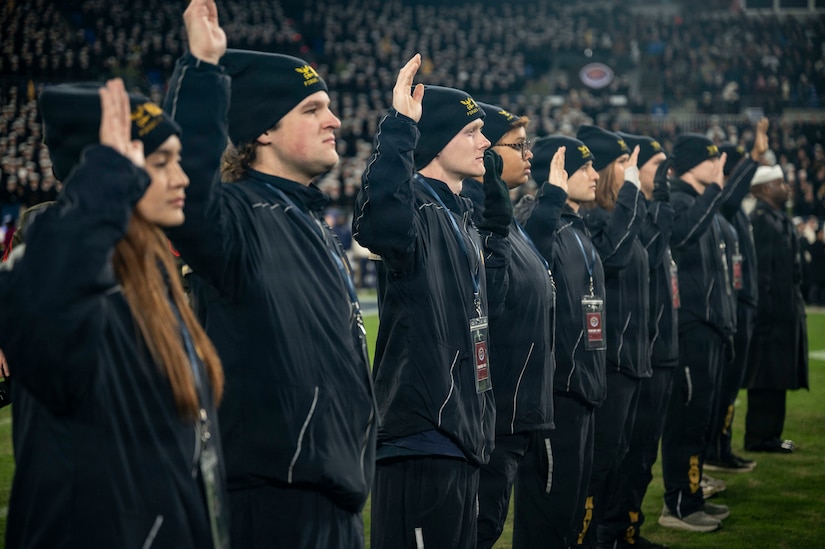
FY25 Sees Best Recruiting Numbers in 15 Years

Left
U.S. War Department: News
FY25 Sees Best Recruiting Numbers in 15 Years
Dec. 22, 2025 |  By Matthew Olay

In fiscal year 2025, the military's recruiting efforts returned to levels not seen in more than a decade. 

"Since November 2024, our military has seen its highest recruiting percentage of mission achieved in more than 15 years," stated Chief Pentagon Spokesman Sean Parnell. 


This fiscal year, all active-duty services made mission. Most reserve components also met their mission goals, with the exception of the Army Reserve, which met 75% of its goal. 

How the active-duty components of each branch met their goals breaks down as follows: 

  • The Army had a goal of 61,000 recruits and attained 62,050, totaling 101.72% of its goal. 
  • The Navy had a goal of 40,600 recruits and attained 44,096, totaling 108.61% of its goal. 
  • The Air Force had a goal of 30,100 recruits and attained 30,166, totaling 100.22% of its goal. 
  • The Space Force had a goal of 796 recruits and attained 819, totaling 102.89% of its goal. 
  • The Marine Corps had a goal of 26,600 recruits and attained 26,600, totaling 100% of its goal. 

All told, the five service branches collectively accomplished their mission with an average completion rate of 103%. 

Department leaders noted several factors that contributed to the strong recruitment numbers.  

"In 2025, the department exceeded our annual active-duty recruitment accession goals across all five services. ... Why? Because we have a commander in chief and a secretary of war who are focused on our troops and our mission, and on ensuring that we remain the most lethal fighting force on the planet," Undersecretary of War for Personnel and Readiness Anthony J. Tata said during a speech at a defense forum earlier this month.  

"Our nation's young people are responding," he added. 


Parnell also noted that leadership was a major factor in this year's recruiting results.  

"If you look at the data from November, from the election of President Trump and then Secretary Hegseth's confirmation thereafter, the numbers that we've seen during that time period have been historic." 

Tata and Parnell co-chair the department's Recruitment Task Force. 

Beyond the quality of leadership in recruitment, driving up numbers, the services have instituted practical improvements that are supporting recruiting gains. These changes include courses that help improve overall aptitude among recruits and enhanced medical screening processes.  

As an example of the latter, a medical records accession pilot program has significantly cut down on waiting times from when a recruit's initial paperwork is submitted to when they are allowed to be taken in by their local Military Entrance Processing Station. 

As little as a year ago, it could take up to 10 days between when a recruiter submits a recruit's initial accession paperwork and when that individual could find out if they have been cleared. Today, it takes one day or less. The new focus on speed helps avoid potential recruits from losing interest in serving.  

Regarding the current fiscal year, the department's recruiting efforts are already off to a strong and promising start, with the department having met nearly 40% of its delayed entry program accession mission at the start of fiscal year 2026.

"This is a historic figure and a testament to our support from the president and the secretary, as well as the great work being done by each of the services," said Tata. "The department is on track to once again meet our recruiting mission." 

There are always challenges in recruiting, with recruiters continuously working to increase interest among the youth market and medical disqualifiers plaguing the potential recruiting pool among them. 

To address some of these, the department is working to counter any pervasive misconceptions among the youth market about what it means to serve by highlighting the benefits of wearing the country's cloth. 

"Recruiting is a no-fail mission," Tata said. "We will continue to maintain focus on sustaining our momentum, meeting our targets and securing the warriors we need to achieve peace through strength."

Right


ABOUT   NEWS   HELP CENTER   PRESS PRODUCTS
Facebook   X   Instagram   Youtube

Unsubscribe | Contact Us


This email was sent to sajanram1986.channel@blogger.com using GovDelivery Communications Cloud on behalf of: U.S. Department of War
1400 Defense Pentagon Washington, DC 20301-1400

Monday, December 22, 2025

2025 Department of War Year in Review: Peace Through Strength

Left
U.S. Department of Defense: Interactive
2025 Department of War Year in Review: Peace Through Strength
Dec. 22, 2025
Secretary of War Pete Hegseth established an ambitious set of goals when he took the oath to lead the department in January 2025, aggressively tackling key priorities based on President Donald J. Trump's "peace through strength" agenda. Here's a look at major changes the department has unleashed in less than a year.
Right


ABOUT   NEWS   HELP CENTER   PRESS PRODUCTS
Facebook   X   Instagram   Youtube

Unsubscribe | Contact Us


This email was sent to sajanram1986.channel@blogger.com using GovDelivery Communications Cloud on behalf of: U.S. Department of War
1400 Defense Pentagon Washington, DC 20301-1400

Flag Officer Announcement for December 22, 2025

Left
U.S. Department of War: Release
View Online
IMMEDIATE RELEASE
Flag Officer Announcement for December 22, 2025
Dec. 22, 2025

Secretary of War Pete Hegseth announced today that the President has made the following nomination:

Navy Rear Adm. Richard E. Seif, Jr., for appointment to the grade of vice admiral, with assignment as commander, Naval Submarine Forces/commander, Submarine Force, U.S. Atlantic Fleet, and commander, Allied Submarine Command, Norfolk, Virginia. Seif is currently serving as program manager, Australia-United Kingdom-U.S. Integration and Acquisition, Washington Navy Yard, Washington, D.C.

Right

Press Advisories   Releases   Transcripts

Speeches   Publications   Contracts


ABOUT   NEWS   HELP CENTER   PRESS PRODUCTS
Facebook  X   Instagram   Youtube

Unsubscribe | Contact Us


This email was sent to sajanram1986.channel@blogger.com using GovDelivery Communications Cloud on behalf of: U.S. Department of War
1400 Defense Pentagon Washington, DC 20301-1400

Today in DOW: July 13, 2026

...