Wednesday, December 17, 2025

Contracts for Dec. 16, 2025

Left
Department of War: Contracts
View Online
FOR RELEASE AT 5 PM ET
Contracts For Dec. 16, 2025

NAVY

The Boeing Co., St. Louis, Missouri, is awarded a $930,771,278 cost-plus-incentive-fee, cost-plus-fixed-fee, indefinite-delivery/indefinite-quantity contract to provide service life modifications for up to 60 F/A-18 E/F Super Hornets in support of the ongoing efforts to extend F/A-18 Block II Super Hornet service life from 6,000 flight hours to 10,000 flight hours, as well as provides for integration of Block III avionics capabilities for the Navy. Work will be performed in San Diego, California (44%); San Antonio, Texas (44%); and St. Louis, Missouri (12%), and is expected to be completed in November 2028. No funds will be obligated at the time of award; funds will be obligated on individual orders as they are issued. This contract action was not competed. Naval Air Systems Command, Patuxent River, Maryland, is the contracting activity (N0001926D0008).

Amentum Technology Inc., Tullahoma, Tennessee, is awarded a $30,942,099 modification to previously awarded contract (N69450-18-D-1800) for base operations support services at Naval Station Mayport, Marine Corps Support Facility Blount Island, and outlying areas. This award brings the total cumulative face value of the contract to $263,795,723. This contract modification is for the exercise of option period seven for an additional 12 months of base operations support services under the basic contract. Work will be performed in Jacksonville, Florida, and is expected to be completed by December 2026. No funds will be obligated at time of award. Fiscal 2026 operation and maintenance, (Navy) (O&M, N); fiscal 2026 O&M, (Marine Corps); fiscal 2026 Navy working capital funds; and fiscal 2026 family housing O&M, N contract funds in the amount of $24,759,541 will be obligated on individual task orders issued during the option period. The Naval Facilities Engineering Systems Command, Southeast, Jacksonville, Florida, is the contracting activity.

Northrop Grumman Systems Corp., San Diego, California, is awarded a $25,303,971 cost-plus-fixed-fee and cost-only modification to a previously awarded contract (N00024-24-C-6400) to exercise options for Joint Counter Radio-Controlled Improvised Explosive Device Electronic Warfare Increment One Block One engineering and sustainment support and associated other direct costs. This contract action combines purchases for the Navy (63%); and the government of Australia (37%), under the Foreign Military Sales (FMS) program. Work will be performed in San Diego, California, and is expected to be complete by January 2027. Fiscal 2025 other procurement (Navy) funds in the amount of $1,699,024 (59%); FMS (Australia) funds in the amount of $1,055,000 (37%); fiscal 2026 research development test and evaluation (Navy) funds in the amount $102,365 (4%), will be obligated at time of award and will not expire at the end of the current fiscal year. Naval Sea Systems Command, Washington, D.C., is the contracting activity.

Alabama Shipyard LLC,* Mobile, Alabama, is awarded a $16,707,619 firm-fixed-price contract (N3220526C1204) for the 102-calendar day shipyard availability for the mid-term availability of Military Sealift Command's hospital ship USNS Comfort (T-AH 20). This contract includes a base work package and two unexercised options for additional work and time, which if exercised, would increase the cumulative value of this contract to $16,845,368. Work will be performed in Mobile, Alabama, beginning Jan. 15, 2026, and is expected to be completed by Apr. 26, 2026. Fiscal 2026 operation and maintenance (Navy) funds in the amount of $16,707,619 are obligated and will expire at the end of the fiscal year. This contract was a small business set-aside solicited via the Government wide Point of Entry website and three offers were received. Military Sealift Command, headquartered in Norfolk, Virginia, is the contracting activity (N3220526C1204).

ARMY

M1 Support Services LP, Denton, Texas, was awarded a $601,135,303 modification (P00205) to contract W9124G-17-C-0104 for aviation maintenance. The modification brings the total cumulative face value of the contract to $4,850,644,617. Work will be performed at Fort Rucker, Alabama, with an estimated completion date of Jan. 15, 2027. Fiscal 2026 operation and maintenance, funds were not obligated at the time of award. Army Contracting Command, Redstone Arsenal, Alabama, is the contracting activity.

Airbus U.S. Space & Defense Inc., Arlington, Virginia, was awarded a $323,734,736 modification (P00214) to contract W58RGZ-22-C-0022 for UH-72 Lakota logistics support and engineering services. Work will be performed in Grand Prairie, Texas, with an estimated completion date of Dec. 31, 2026. Fiscal 2026 operation and maintenance, Army funds in the amount of $100,084,643 were obligated at the time of the award. Army Contracting Command, Redstone Arsenal, Alabama, is the contracting activity. 

AIR FORCE

Vertex Aerospace LLC, Madison, Mississippi, was awarded an undefinitized contract action with a not-to-exceed price of $ 20,995,905 for F-16 Systems Program Office Foreign Military Sales (FMS) support. This contract action involves FMS support for contractor logistics support (CLS) for the Iraq F-16 Program at Martyr Brigadier General Ali Flaih Air Base, a government of Iraq owned military base. Work will be performed at Martyr Brigadier General Ali Flaih Air Base, Iraq, and is expected to be completed by May 31, 2031.  This contract involves FMS to Vertex Aerospace LLC. This award is the result of a sole source acquisition under contract FA823225CB004. FMS funds in the amount of $12,945,335 are being obligated at the time of award. Air Force Life Cycle Management Center, Hill Air Force Base, Utah, is the contracting activity. (Awarded on Dec. 1, 2025)

DEFENSE LOGISTICS AGENCY

UPDATE: Hologic Sales and Service LLC, Marlborough, Massachusetts (SPE2D1-26-D-0005, $95,000,000), has been added as an awardee to the multiple award contract for medical equipment and accessories for the Defense Logistics Agency Electronic Catalog, issued against solicitation SPE2DH-21-R-0002 and awarded Feb. 10, 2022. The contracting activity is Defense Logistics Agency Troop Support, Philadelphia, Pennsylvania.

UPDATE: Somo Lens LLC,* Santa Fe Springs, California (SPE2DF-26-D-0004, $37,500,000) has been added as an awardee to the multiple award contract for optical lens program for the Defense Logistics Agency Electronic Catalog, issued against solicitation SPE2DE-24-R-0002 and awarded on May 1, 2024. The contracting activity is Defense Logistics Agency Troop Support, Philadelphia, Pennsylvania. 

CORRECTION: The contract announced on Sept. 29, 2025, for A-GAS US Inc., Bowling Green, Ohio (SPE4A7-25-D-0386) for $31,442,629 was not awarded.  

*Small business

Right

Press Advisories   Releases   Transcripts

Speeches   Publications   Contracts


ABOUT   NEWS   HELP CENTER   PRESS PRODUCTS
Facebook   X   Instagram   Youtube

Unsubscribe | Contact Us


This email was sent to sajanram1986.channel@blogger.com using GovDelivery Communications Cloud on behalf of: U.S. Department of War
1400 Defense Pentagon Washington, DC 20301-1400

NORAD Celebrates 70 Years of Tracking Santa

Left
U.S. Department of War: Feature
NORAD Celebrates 70 Years of Tracking Santa
Dec. 16, 2025 | By David Vergun

This Christmas season marks seven decades of the North American Aerospace Defense Command tracking Santa Claus on radar as he flies his reindeer-powered sleigh around the globe. 

"NORAD tracks Santa, but only Santa knows his route, which means we cannot predict where and when he will arrive at your house," said a senior NORAD official. 

Fighter pilots have intercepted Santa many times over the years. When they do, the pilots tip their wings in greetings and often take photos, the official said. 

NORAD has Santa cams in space that take video of him flying. These videos appear online almost every hour on Christmas Eve. 

NORAD's Santa Operations Center is fully functional beginning Dec. 24 at 4 a.m. MST. Children can call 877-446-6723 to talk directly to a Santa tracker, who will be able to tell callers his current location. Operators are available until midnight. 

More than 1,000 Canadian and American uniformed personnel, War Department civilians and local participants at Peterson Space Force Base in Colorado Springs, Colorado, where NORAD is located, volunteer their time Christmas Eve to answer the hundreds of thousands of phone calls that come in from around the world. 

Santa is currently at the North Pole where he lives with Mrs. Claus and the elves, who make toys and take care of the reindeer year-round. Each year on Dec. 24, Santa Claus and his reindeer launch from the North Pole very early in the morning for their famous trip around the world. 

The minute they launch, NORAD starts to track him, the official said. 

Besides tracking Santa, NORAD is responsible for aerospace and maritime warning in defense of North America. The organization is jointly run by the U.S. and Canadian militaries. 

NORAD's predecessor, the Continental Air Defense Command, began tracking Santa in 1955. NORAD took over in 1958. 

Right


ABOUT   NEWS   HELP CENTER   PRESS PRODUCTS
Facebook   X   Instagram   Youtube

Unsubscribe | Contact Us


This email was sent to sajanram1986.channel@blogger.com using GovDelivery Communications Cloud on behalf of: U.S. Department of War
1400 Defense Pentagon Washington, DC 20301-1400

Sustaining Expeditions: New Tech Keeps Warfighters Fed in Arctic Conditions

Left
U.S. Department of War: Feature
Sustaining Expeditions: New Tech Keeps Warfighters Fed in Arctic Conditions
Dec. 16, 2025 | By Katie Lange

Batteries for cellphones and other small devices deplete quickly outside in the winter, and that's no different for warfighters in the field. To make sure they're focused on the mission — and not the temperature or malfunctioning equipment — War Department experts are creating specialized technology and adapting current equipment to survive in frigid climates.

More countries, including U.S. adversaries, are increasing their presence in the Arctic thanks to its vast natural resources and new shipping lanes that have opened due to ice melt. Those changes have helped to shift the future of expeditionary warfare toward small, self-sustained units that can function in the extreme cold. Supply lines aren't well-established in those areas, so units often have to carry their own food and cooking equipment. 

In temperatures that are often minus 25 degrees Fahrenheit or below, currently fielded cooking equipment used by troops just won't cut it. Materials used throughout field feeding systems — such as plastic, rubber and textiles — can freeze and break, while other items lose their ability to function, affecting a warfighter's productivity or even shutting down operations.  

At the Army Combat Capabilities Development Command Soldier Center's Combat Feeding Division in Natick, Massachusetts, researchers are working to create and supply equipment that will keep warfighters on task for mission success. While the division's main focus is the nutritional needs of warfighters, how they're able to prepare their meals to meet those needs is also important.  

That's where Ben Williams, a mechanical engineer and the division's self-described de facto cold-weather sustainment expert, comes in. He's helped develop numerous cold-weather field feeding and sustainment technologies for expeditionary forces.  

Until recently, portable kitchens used in the field were built to feed between 250 to 800 soldiers and weren't designed to work below minus 25 degrees. So, Williams and his colleagues set out to design and build newer equipment that's smaller in scale but offers the same capabilities in a cost-effective expeditionary package.  

Thus was born the Expeditionary Field Feeding Equipment System, or EFFES, a collapsible kitchen system developed with the help of the Marine Corps as a way to feed about 100 to 150 warfighters.   

"It's basically a kitchen in a box," Williams said of the tent, equipment and gear that fits in a pallet-sized container. "It's very mobile, very lightweight. You can airdrop it, you can sling load it, put in the back of a pickup truck. You don't need standardized military equipment to transport it." 

The EFFES cooks using most standard fuel types and has no external power source; it's battery-powered and self-sustained through thermoelectrics, a process where a temperature difference creates an electric current. A majority of its components are commercially available, keeping costs much lower than if parts were custom built. It also helps soldiers in the field when it comes to replacements.  

"If something breaks, they can just use unit dollars to replace it," Williams said. "And since most components are commercial off-the-shelf, the likelihood that they'll be available and in stock is high. This ensures that equipment in the field remains operationally available." 

Service Member Tested 

The Combat Feeding Division has tested 10 EFFES prototypes over the past three years in several locations, including with units at the Marine Corps Mountain Warfare Training Center in central California and by the Army's 11th Airborne Division in Alaska during Joint Pacific Multinational Readiness Center exercises.  

It was also tested by the Army's Cold Regions Research Engineering Laboratory during one of its yearly Arctic-led international expeditions, where the system was transported across 1,300 kilometers, and minus 30 degrees was the daily operational temperature.   

"They were trading with the native population … cooking moose meat and making biscuits," Williams said. "Military personnel who had no food service background were able to utilize the equipment with minimal training." 

So, how does this kitchen-in-a-box work in the extreme cold? Underneath a small, insulated tent, its users set up three cooking stations, each of which uses an insulated 2-gallon fuel tank that's attached to a Marine Corps standard squad stove known as the MSR XGK stove, which is usually intended for individual use.  

"We're going to use three of those to cook for 150 people," Williams said. It's something they've managed by modifying the burner to triple the heat output and make some other functional tweaks.  

"We can cook faster, and the fuel consumption is drastically lower," Williams said. "We're using 80% less fuel than burners we use in our other kitchens. It'll run for about 30 hours off one tank. It's a big difference." 

To pressurize the fuel bottles, they supplemented the stove's manual hand pumps with insulated automatic air pumps.  

Among other items, the EFFES also comes with flame-resistant, insulated covers that can be used with the system's pots, pans and ovens; special adapters for heating group rations; and carbon monoxide sensors for safety. The larger components are collapsible. 

"It's got everything you need for prepping, cooking, serving and sanitation," Williams said.  

Crews also have specially insulated backpacks to hold 5-gallon water bladders that won't freeze and can be folded when empty.  "If you leave with 120-degree water from the tap, you can keep it above freezing for at least three days at minus 40 degrees, just sitting outside," Williams said.  

Climatized Indoor Testing 

Williams and crew test all the equipment at the nearby U.S. Army Research Institute of Environmental Medicine's Doriot Climatic Chamber, which for decades has tested the effects of extreme environments on people and equipment.  

"Every climate you could possibly imagine … we can re-create," said Jeff Faulkner, the facility's manager.  

The chambers' temperatures can range from 165 to minus 65 degrees, and they can create 40 mph of wind, rain and snow. Each chamber has inclining treadmills that can handle up to five soldiers at 15 mph on a 12-degree incline. Smaller conditioning rooms have the same capabilities as the chambers, except they can drop to minus 72 degrees. 

Inside a tent in one of the conditioning rooms, Williams recently tested a prototype fireproof insulated combat equipment stove, known as the ICE stove. Unlike the EFFES, the ICE stove weighs 35 pounds, folds up and is transportable like a duffle bag.  

"Everything's thermoelectric, so there's no external power," Williams said.  

The ICE stove's burner, which is contained in an aluminum cradle for safety, is able to rapidly heat water or reheat meals, ready-to-eat entrees in temperatures down to minus 60 degrees. It comes with a cook pot for water and a second tank on top that can melt snow. There's also an exhaust tube that allows the ICE stove to vent out the top of the tent, as well as carbon dioxide and monoxide sensors. 

"The whole point of this is to rapidly heat enough water for a platoon of 50 people for their meal, cold water rations," Williams said. "If you want to heat MRE pouches, other prepackaged foods or just some biscuits, you can do that in the top section."   

When warfighters want to create hot water or reheat their MREs outside the tent, the ICE stove's insulated wrap maintains performance and keeps the water or rations warm. Water is then dispensed through a lithium-ion battery-powered electric pump and hose — much like a gas pump.  

"A lot of things break instantaneously at [minus 40 or minus 60 degrees]. Rubber is one of them, so you have to get a special platinum-infused silicone hose, so it remains flexible," Williams said. To keep the pump and other external parts running optimally, disposable hand warmers can be stuffed in specially designed insulated pockets.  

The stove comes with several other small side components, including plasma lighters, matchless fire starters, LED headlamp and a remote temperature monitor that can operate from several hundred feet away.  

"The operator can be doing other things while his water or rations are heating. You don't need to sit here and watch it and dedicate a soldier solely to cooking," Williams said.  

The water tanks can easily be exchanged to turn the stove into a tent heater as well, Williams said. A thermoelectric module can be plugged into the electric pump's battery, acting as a power source. When Williams tested it inside a chamber at minus 50 degrees, it produced a small amount of heat, but it was enough to raise the temperature to a survivable level — about 62 degrees.  

 "We really want it to be at least 40 degrees without anybody in there, and we're getting to about 47 degrees," Williams said.  

Testing Other Cold-Weather Creations 

Meanwhile, Faulkner said he's also seen researchers at the climate chamber test a heated bodysuit that went inside of a high-altitude, low-opening jumpsuit. HALO jumping is a technique used for stealthy infiltration into an area in which the jumper exits an aircraft, often at about 30,000 feet, and freefalls to a lower altitude before deploying their parachute.  

Since the air is thin and freezing at those heights, specialized equipment is required. The test mimicked a three to five-minute freefall.  

"[The suit] would keep them warm instead of using this huge, bulky insulated uniform," Faulkner said. "And to mimic the falling, they had piles of giant box fans blowing in [the volunteer participant's] face in minus 65 degrees." 

Just recently, the chamber hosted a company working with an Army drone team to test batteries and computer systems in extreme cold temperatures. 

Faulkner said that while most of the equipment tested during his years at Doriot have been for cold climates, some warm-weather technology has been prototyped. Researchers tested a microclimate cooling vest that explosive ordnance disposal technicians and others who wear various nonbreathable suits could wear to prevent heat-related injuries.  

Right


ABOUT   NEWS   HELP CENTER   PRESS PRODUCTS
Facebook   X   Instagram   Youtube

Unsubscribe | Contact Us


This email was sent to sajanram1986.channel@blogger.com using GovDelivery Communications Cloud on behalf of: U.S. Department of War
1400 Defense Pentagon Washington, DC 20301-1400

Readout of December 2025 U.S.-China Defense Policy Coordination Talks

Left
U.S. Department of War: Release
View Online
IMMEDIATE RELEASE
Readout of December 2025 U.S.-China Defense Policy Coordination Talks
Dec. 16, 2025

Mr. Alvaro Smith, Deputy Assistant Secretary of War for China, Taiwan, and Mongolia, met with People's Republic of China (PRC) Major General Ye Jiang, Deputy Director of the Central Military Commission Office for International Military Cooperation, in Washington, D.C. for the 19th annual U.S.-China Defense Policy Coordination Talks from December 15-16.

DASW Smith reiterated the Department of War's support for a wider range of military-to-military communications with the People's Liberation Army (PLA) with the goal of supporting strategic stability as well as crisis deconfliction and de-escalation, more broadly. DASW Smith explained how such lines of communication align with and help to reinforce ongoing efforts by President Trump to achieve a stable peace and respectful relations between the United States and China. DASW Smith also reiterated that America's interests in the Indo-Pacific are significant, but also scoped and reasonable, and that DoW stands ready to defend them.

This week's talks follow Secretary of War Pete Hegseth's meeting with China's Minister of National Defense Admiral Dong Jun on the sidelines of the ASEAN Defense Ministers Meeting Plus (ADMM+) on October 31.

Right

Press Advisories   Releases   Transcripts

Speeches   Publications   Contracts


ABOUT   NEWS   HELP CENTER   PRESS PRODUCTS
Facebook  X   Instagram   Youtube

Unsubscribe | Contact Us


This email was sent to sajanram1986.channel@blogger.com using GovDelivery Communications Cloud on behalf of: U.S. Department of War
1400 Defense Pentagon Washington, DC 20301-1400

U.S. Holds 171st Repatriation Ceremony in Vietnam

Left
U.S. War Department: News
U.S. Holds 171st Repatriation Ceremony in Vietnam
Dec. 16, 2025 |  By Air Force Lt. Col. George Tobias, Defense POW/MIA Accounting Agency

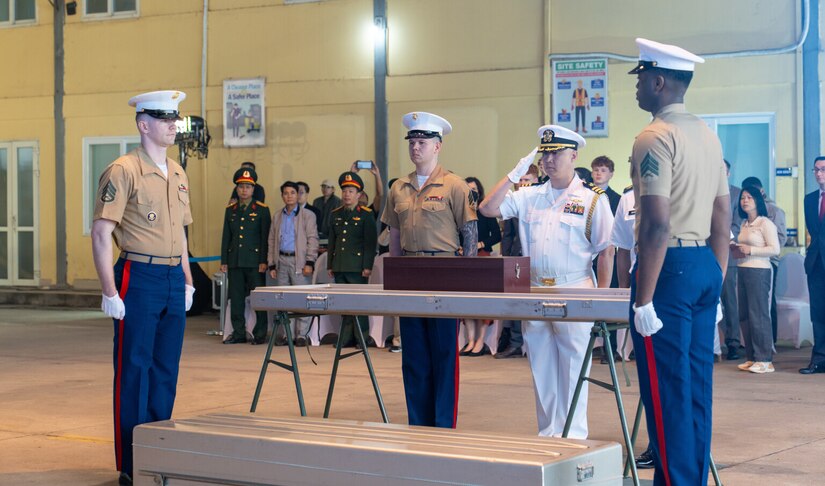
The Defense POW/MIA Accounting Agency received possible remains of a service member during a repatriation ceremony at the Gia Lam Airfield, Vietnam, Dec. 13.

During the 171st repatriation ceremony held by the two countries, representatives from the Vietnam Office for Seeking Missing Persons handed over remains to the accounting agency thought to be associated with a U.S. Air Force F-105 crash site in Lao Cai Province.

Kelly McKeague, DPAA director, and Le Cong Tien, VNOSMP director, presided over the event, which included dignitaries from the U.S. Embassy in Hanoi and senior ministry officials from Vietnam.

McKeague thanked the Vietnamese partners for their support.

"Thank you to the government of Vietnam, whose leaders in the early 1980s exhibited a great deal of faith and compassion to assist the United States in searching for and recovering the remains of American soldiers, sailors, Marines and airmen who were missing in action," McKeague said.

He noted that this assistance began 10 years after the war and 10 years before the normalization of diplomatic relations. 

In a released statement on the ceremony, U.S. Embassy in Hanoi officials stated, "The joint humanitarian effort is committed to locating and identifying U.S. service members who went missing in the war in Vietnam. These sustained efforts have been implemented for 40 years by the two governments."

Embassy officials also noted that "MIA cooperation is one of the long-standing pillars in the U.S.-Vietnam bilateral relationship that seeks to settle the war legacies between the two countries."

The potential remains were recovered by one of the two Vietnamese unilateral recovery teams, part of the 161st Joint Field Activity, which started in late October and concluded at the beginning of December; the teams continued operations during the U.S. government's lapse in appropriations.

"When DPAA teams were unable to travel due to the government shutdown, two Vietnamese recovery teams operated for 45 days, each augmented by 60 local villagers. It was the team in Yen Bai Province that recovered the remains that will soon be repatriated," McKeague said.

McKeague ended his remarks by thanking Vice Minister Giang, Deputy Minister Chien, and VNOSMP partners.

The potential remains were examined Dec. 5 in Hanoi by U.S. and Vietnamese forensic specialists, and it was determined that they might belong to a U.S. service member. DPAA will transport the potential remains to the Daniel K. Inouye DPAA Center of Excellence in Honolulu for further analysis.

To date, 1,067 U.S. service members missing in action have been identified from the Vietnam War.

Right


ABOUT   NEWS   HELP CENTER   PRESS PRODUCTS
Facebook   X   Instagram   Youtube

Unsubscribe | Contact Us


This email was sent to sajanram1986.channel@blogger.com using GovDelivery Communications Cloud on behalf of: U.S. Department of War
1400 Defense Pentagon Washington, DC 20301-1400

Today in DOW: July 9, 2026

...