The UN agency that assists Palestine refugees, UNRWA, said that Israeli police raided its compound in East Jerusalem early on Monday, representing "a new challenge to international law."
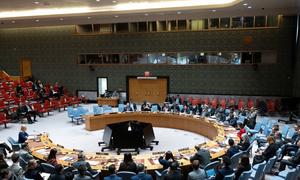
The Organization for Security and Co-operation in Europe (OSCE) chief on Monday urged the UN Security Council to uphold core principles of sovereignty, territorial integrity and human rights, warning that Russia's war in Ukraine continues to undermine European security.
The world is witnessing an alarming erosion of respect for international law, with conflicts increasingly targeting civilians and heightening the risk of atrocity crimes, warns the United Nations' newly appointed Special Adviser on the Prevention of Genocide.
Civilians across Ukraine endured a surge in deadly strikes over the weekend, with the UN warning of an "alarming pattern" of intensifying hostilities and mounting damage to essential services as temperatures continue to drop.
As Sudan's civil war intensified on Monday, top UN officials condemned the killing of dozens of children in drone strikes in South Kordofan state – and the targeting of first responders trying to help the wounded.
The UN and partners are seeking $23 billion to provide lifesaving support next year to 87 million people worldwide affected by war, climate disasters, earthquakes, epidemics and crop failures.
U.S., Australian Cooperation on Land, Air, Sea, Industrial Base Top Topics at 40th AUSMIN
Dec. 8, 2025 | By C. Todd Lopez
The U.S. and longtime ally Australia met at the State Department in Washington today for the 40th annual Australia-United States Ministerial Consultations.
"This is an incredibly strong alliance," said Secretary of State Marco A. Rubio during remarks in advance of the talks. "In fact, as we were discussing a few moments ago, is our only ally that has fought with us in every war over the last — certainly over the last four or five decades — and we're very grateful to them for that. And this is a very strong partnership. It's a strong alliance, and what we want to do is continue to build on it."
As part of the meeting, Rubio and Secretary of War Pete Hegseth met with their Australian counterparts, Deputy Prime Minister and Defense Minister Richard Marles and Foreign Affairs Minister Penny Wong.
Hegseth noted work being done on enhanced force posture, which will benefit both nations, as a growing military-to-military partnership is central to maintaining the strong relationship between the U.S. and Australia.
"We're upgrading the infrastructure on airbases in Queensland and the Northern Territory," Hegseth said. "That allows for additional U.S. bomber rotations. We're upgrading logistics and infrastructure in Darwin so more U.S. Marines can do rotational deployments and pre-positioning MV-22 Ospreys. This establishes new and resilient logistics networks across Australia."
Another big issue for the U.S. and Australia is strengthening the defense industrial base, the collection of private-sector companies that design and manufacture hardware and supplies for militaries, including aircraft, ships, submarines, missiles, bombs, ammunition, firearms and combat vehicles.
"We're deepening our cooperation on the defense industrial base — cooperation on guided weapons production and lethal capabilities, two-year roadmaps on Australia's guided weapons and explosive ordinance enterprise, groundbreaking cooperative actions on things like — and precision strike missiles," Hegseth said. "And we're working towards coproduction and co-sustainment of hypersonic attack cruise missiles — co-sustainment air-to-air missiles cooperative programs across the board, including Mark 54 torpedoes."
A key part of building weapons systems for both the U.S. and Australia is access to rare Earth and other critical minerals. In October, both nations signed a framework to support the supply of raw and processed critical minerals and rare earths, which are important to the commercial and defense industries of both countries.
"Critical minerals and rare earths are a huge part of ensuring both countries can operate the way we need to in that region and around the world," Hegseth said.
The discussion also focused on the Australia, U.K. and U.S. trilateral security agreement, known as AUKUS, which has been in place for just over three years.
The War Department recently concluded a review of the AUKUS agreement meant to identify opportunities to strengthen it and ensure its long-term success, in alignment with the president's "America First" agenda.
In October, President Donald J. Trump confirmed the U.S. is going "full steam ahead" on the AUKUS deal.
"As we move ... full steam ahead on AUKUS, we applaud Australia's upcoming delivery of an additional $1 billion to help expand U.S. submarine production capacity," Hegseth said. "We're strengthening AUKUS so that it works for America, for Australia and for the U.K."
The AUKUS agreement includes two pillars. The first pillar involves the delivery of a conventionally armed, nuclear-powered submarine capability to Australia, as well as significant investments in the industrial bases of all three partner nations.
As part of that plan, Australia will buy three Virginia-class submarines from the U.S. to be delivered in the 2030s. Together, all three partner nations will also develop a new platform called "SSN-AUKUS," which is expected to be ready for use by the U.K. in the 2030s and by Australia in the 2040s.
The second AUKUS pillar involves enhancing joint capabilities and interoperability between the three nations.
This email was sent to sajanram1986.channel@blogger.com using GovDelivery Communications Cloud on behalf of: U.S. Department of War 1400 Defense Pentagon Washington, DC 20301-1400