Tuesday, December 10, 2024

Alert: Security Council hears of ongoing imperative to end violence in eastern DR Congo

Welcome to the United Nations
View in browser
Click 'Download images' to view images
UN News
Global perspective Human stories
Alert 9 December 2024
Security Council hears of ongoing imperative to end violence in eastern DR Congo
[UN News photo]

The UN Special Representative for the Democratic Republic of the Congo (DRC) briefed the Security Council on Monday on recent developments, including political disagreements over constitutional reform and escalating insecurity in the east. 

Read more
UN logo white
facebook twitter soundcloud
COPYRIGHT    |    FAQ    |    FRAUD ALERT    |    PRIVACY NOTICE    |    TERMS OF USE
Unsubscribe    |    Update preferences

Readout of Deputy Secretary of Defense Kathleen Hicks' Meeting With UK Permanent Under Secretary for the Ministry of Defence David Williams at the U.S.-UK Defense Dialogue

Left
Release
View Online
IMMEDIATE RELEASE
Readout of Deputy Secretary of Defense Kathleen Hicks' Meeting With UK Permanent Under Secretary for the Ministry of Defence David Williams at the U.S.-UK Defense Dialogue
Dec. 9, 2024

Pentagon Spokesman Eric Pahon provided the following readout: 

Deputy Secretary of Defense Kathleen Hicks and Vice Chairman of the Joint Chiefs of Staff Admiral Christopher Grady attended the U.S.-UK Defense Dialogue in London, United Kingdom, today with Permanent Under Secretary for Defence David Williams and Vice Chief of the Defence Staff General Dame Sharon Nesmith to discuss advancement in key areas of partnership across strategy, industrial base resilience,  capabilities development, and current events, to include Syria.

The strategy-focused portion of the dialogue included a discussion of the recently-announced UK Strategic Defense Review, cooperation on strategic readiness, and Russia's unprovoked war of aggression in Ukraine.

Discussions on U.S. and UK industrial base resilience included a review of the National Defense Industrial Strategy (NDIS) Implementation Plan, the EU-led European Defense Industrial Program, and defense innovation and rapid acquisition programs- to include Replicator. 

Deputy Secretary Hicks emphasized that collective security is made stronger when we promote the free flow of ideas, materiel, and systems across the Atlantic. She also noted that engaging international partners and Allies is critical to enabling interoperability and promoting international and government-to-government industrial cooperation. 

The Deputy Secretary and Permanent Secretary also discussed the Global Combat Air Programme and reducing barriers to collaboration- to include reducing barriers to information sharing necessary to the success of the AUKUS trilateral partnership.

Deputy Secretary Hicks noted that initiatives like AUKUS demonstrate an ability to effectively collaborate, address shared objectives, and preserve rules-based international norms.

She also highlighted that combined efforts toward reducing barriers to information sharing will ultimately drive increased interoperability and help to operationalize integrated deterrence.

Deputy Secretary Hicks thanked Permanent Secretary Williams for his cooperation and effort over the last four years, which has helped to deepen the enduring special defense relationship between the U.S. and the UK. 

The twice-yearly U.S.-UK Defense Dialogue was established to focus high-level attention on strategic and acquisition issues, as well as technical innovation. The last U.S.-UK defense dialogue was held at the Pentagon in Washington, D.C., on June 5, 2024.

Right

Press Advisories   Releases   Transcripts

Speeches   Publications   Contracts


ABOUT   NEWS   HELP CENTER   PRESS PRODUCTS
Facebook   Twitter   Instagram   Youtube

Unsubscribe | Contact Us


This email was sent to sajanram1986.channel@blogger.com using GovDelivery Communications Cloud on behalf of: U.S. Department of Defense
1400 Defense Pentagon Washington, DC 20301-1400

Austin Thanks Carrier Crew for Bringing Capability to Indo-Pacific Region

Left
News
Austin Thanks Carrier Crew for Bringing Capability to Indo-Pacific Region
Dec. 9, 2024 | By David Vergun

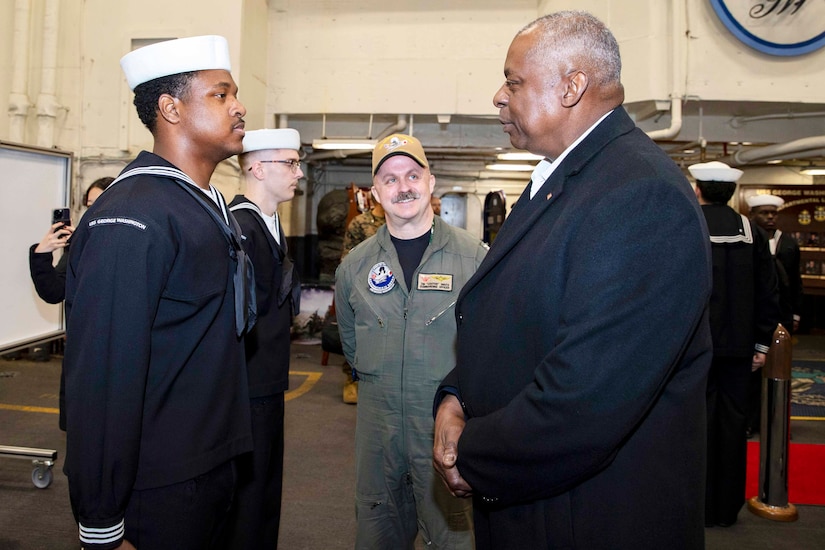
Secretary of Defense Lloyd J. Austin III today, visited the USS George Washington, docked at Fleet Activities in Yokosuka, Japan, to thank sailors for their service and sacrifice in support of the U.S. military, the U.S.-Japan alliance and a free and open Indo-Pacific region. 

To the sailors assembled on the flight deck, Austin told them that "you bring to this theater significant capability." 

The secretary described the Indo-Pacific as the theater where China is the only nation in the world with the intent and increasing capability to change the rules-based international order. 

"We want to see this region remain open to freedom of navigation and the ability to fly the skies in international airways … so we will work with allies and partners to ensure we can do just that," he said. 

"When America sends a message that it cares, it typically sends a United States Navy vessel. When America wants to send a message that it really cares, it sends a carrier battle group. What you are doing and what you are part of is significant. It is a significant element in our national defense strategy," he said. 

The George Washington is currently under maintenance and Austin extolled the work the crew is doing to get the carrier back to sea. 

Once underway again, the ship will carry the advanced F-35C aircraft squadron, based further south in Japan at Marine Corps Air Station Iwakuni. 

"That's a significant milestone for U.S. presence in the Indo-Pacific, because this is the first time that the Navy's forward-deployed carrier air wing includes fifth-generation aircraft," said a senior defense official. 

The George Washington, commissioned in 1992, has seen numerous deployments worldwide, including disaster relief after the 2011 earthquake and tsunami in northeast Japan. 

Right


ABOUT   NEWS   HELP CENTER   PRESS PRODUCTS
Facebook   Twitter   Instagram   Youtube

Unsubscribe | Contact Us


This email was sent to sajanram1986.channel@blogger.com using GovDelivery Communications Cloud on behalf of: U.S. Department of Defense
1400 Defense Pentagon Washington, DC 20301-1400

Monday, December 9, 2024

To Stay on Path, Defense Space Programs Need Domestic Software Developers

Left
News
To Stay on Path, Defense Space Programs Need Domestic Software Developers
Dec. 9, 2024 | By C. Todd Lopez

During the COVID-19 pandemic, shortages of electronic components slowed down development of satellites headed to the Space Development Agency. But it's not only parts and subcomponents that affect the timeline of satellite delivery, said the agency's director. 

"Even though it takes a while to get the hardware and the supply chain built up to actually build the satellites, it doesn't matter what you see on the schedule on day one, I'll tell you right now ... software is always on your critical path, mostly because you can't start a lot of the software until you have some of the hardware," said Derek Tournear, speaking Saturday at the Reagan National Defense Forum in Simi Valley, California. 

The SDA is building the Proliferated Warfighter Space Architecture, which will eventually include hundreds of satellites, delivered in tranches every two years, with each tranche providing more capability than the last. 

The network of hundreds of optically connected satellites will deliver two primary capabilities to warfighters on the ground. The first is beyond line-of-sight targeting for ground and maritime time-sensitive targets, which includes mobile missiles and ships, for instance. The system will provide the ability to detect those targets, track them, calculate a fire control solution and deliver that solution down to a weapons platform so the target can be destroyed. The second capability is similar to the first but for enemy missiles already in flight. 

Right now, Tournear said, Tranche 0 of the PWSA is already in orbit. That includes about 27 satellites. Tranche 1 will come in a few months, he said, which means about 160 satellites in space by next year to provide operational capability to service members on the ground. 

The Tranche 0 satellites, he said, launched about seven months late due to supply chain issues that resulted from COVID-19, including, among other things, an inability to buy resistors. 

Tranche 1's launch will be delayed as well, he said, also due to supply chain issues. But now, he said, it's not resistors, but much more complex parts. 

"We can buy resistors all day long now, but there's a difference between being able to manufacture an optical terminal or a reaction wheel on the order of single digits versus being able to ramp that up to where I need 100 of them," he said. "And obviously people were a little optimistic in how long it would take them to ramp up their manufacturing lines. And we pushed them. We pushed them pretty strongly on that." 

Now, he said, the supply chain for parts needed to make satellites has caught up to what's needed by SDA. But it's not only parts that satellites need, Tournear said, its software as well. 

"Supply chain is not only supply chain in the hardware and being able to build things, but we also need a robust industrial base that can create software, test software, get the software ready to go, and build that capability up," he said. 

Right now, Tournear said, much of the industrial base relies on foreign entities to produce software. It's something he said he'd like to see change. 

"It's one of the things that we've kind of said we're worried about that at the Space Development Agency," he said. "We want our flight software on our satellites to be written in the U.S., because that's one of the supply chain interdiction things that I'm worried about. And so that's been a bottleneck." 

Tournear was also clear that he looks to America's "industrial base" to build the PWSA, not just the defense industrial base. 

"I want people to also ... stop thinking about the defense industrial base," he said. "We don't look at the defense industrial base. We look at the entire industrial base. And by the way, if you happen to do defense as part of that industrial base, more power to you. But we want to leverage the commercial side of that: hardware and software, because those are both critical." 

Right


ABOUT   NEWS   HELP CENTER   PRESS PRODUCTS
Facebook   Twitter   Instagram   Youtube

Unsubscribe | Contact Us


This email was sent to sajanram1986.channel@blogger.com using GovDelivery Communications Cloud on behalf of: U.S. Department of Defense
1400 Defense Pentagon Washington, DC 20301-1400

DOW Featured Photos

...