Saturday, October 5, 2024

Deputy Secretary of Defense Kathleen Hicks Travels to Naval Surface Warfare Center Indian Head Division and Naval Surface Warfare Center Dahlgren Division

Left
Release
View Online
IMMEDIATE RELEASE
Deputy Secretary of Defense Kathleen Hicks Travels to Naval Surface Warfare Center Indian Head Division and Naval Surface Warfare Center Dahlgren Division
Oct. 4, 2024

Pentagon Spokesman Eric Pahon provided the following readout:

Deputy Secretary of Defense Kathleen Hicks visited to Naval Surface Warfare Center (NSWC) Dahlgren Division in King George County, Virginia, and NSWC Indian Head Division in Charles County, Maryland, today to view Navy research, development, testing and evaluation projects, including counter-Uncrewed Systems technologies (c-UXS) and energetics.

At NSWC Dahlgren, the Deputy Secretary viewed multiple c-UXS technologies in development, including directed energy and high-energy lasers. Recent events in the Red Sea, Ukraine and Israel, have accentuated the urgency with which the Department must adopt innovative operational concepts and new capabilities such as directed energy to counter emerging threats. 

The work being done at NSWC Dahlgren, alongside Defense Industrial Base partners, will help advance U.S. understanding of how to better protect our warfighters from UXS, decrease costs, and enable the U.S. military to counter adversary directed energy and high-energy laser systems.  

The Deputy Secretary also visited the Critical Infrastructure Defense Analytic Center, which she authorized in February 2022. The Critical Infrastructure Defense Analytic Center is part of the U.S. Department of Defense's efforts to enhance the security and resilience of critical infrastructure. This center focuses on developing advanced analytical capabilities to assess and manage risks to critical infrastructure, ensuring the continued operation of essential services in the face of various threats.

During her visit, the Deputy also toured and received briefings on the NSWC Dahlgren Hypersonic Integration and Test Facility, which is home to testing facilities important to Department of Defense hypersonic weapons development. Since 2016, NSWCDD has conducted integrated air and missile defense analyses focused on hypersonic missiles. The analysis has ranged from single ship middle-term studies to force-level far-term analyses that identify capability gaps and possible solutions available through science and technology efforts. Dahlgren's efforts include key roles in the development of offensive and defensive hypersonic missile systems. NSWC Dahlgren brings specialized modeling, simulation, and ground testing capabilities to assess the lethality and effectiveness of weapon systems used in hypersonic engagements.

Also at NSWC Dahlgren, the Deputy Secretary met with civilian employees to discuss challenges and opportunities facing the civilian workforce.

Deputy Secretary Hicks then visited NSWC Indian Head, the Navy's premier public arsenal and center for energetics research, development and manufacturing. As a foundational layer of the nation's munitions industrial base, NSWC Indian Head delivers the full spectrum of energetics solutions from research and development to test and evaluation, through product delivery, fleet support and the final phase of demilitarization and explosive ordnance disposal.

While there, the Deputy Secretary was briefed on how NSWC Indian Head has partnered with private industry to bolster the nation's Defense Industrial Base on programs from solid rocket motor manufacturing to warhead development. Deputy Secretary Hicks also viewed some of the more than 500 projects comprising the Energetics Comprehensive Modernization Plan, a $2.7 billion, 15-year modernization plan to bolster the nation's Energetics Defense Industrial Base and increase wartime readiness and manufacturing.

During her visit, Deputy Secretary Hicks toured NSWC Indian Head's detonation complex and viewed a live demonstration of NSWC Indian Head staff conducting testing on energetic materials. As the nation's premier design and development agent for underwater warheads and explosives, the research conducted by staff at NSWC Indian Head has led to the enhanced lethality of mines, torpedoes and missiles as well as the first novel underwater explosive in 40 years.

Deputy Secretary Hicks concluded her visit by touring NSWC Indian Head's mix/cast/cure complex, which is responsible for a wide range of energetics development and manufacturing, while meeting with the workforce responsible for the production process, and pack-out phases of solid rocket motors, warheads, and mines.

The labs at Dahlgren and Indian Head are part of the larger 10-Division Enterprise known as the Navy Surface and Undersea Warfare Centers.

Throughout her travel to NSWC Dahlgren and NSWC Indian Head, Deputy Secretary Hicks focused on the people, facilities, and partnerships which are helping the Department of Defense develop innovative solutions to modern battlefield threats and bolster supply chains to ensure the U.S. military can support munitions and energetics needs for our warfighters.

Right

Press Advisories   Releases   Transcripts

Speeches   Publications   Contracts


ABOUT   NEWS   HELP CENTER   PRESS PRODUCTS
Facebook   Twitter   Instagram   Youtube

Unsubscribe | Contact Us


This email was sent to sajanram1986.channel@blogger.com using GovDelivery Communications Cloud on behalf of: U.S. Department of Defense
1400 Defense Pentagon Washington, DC 20301-1400

This Small Kentucky Plant Makes Most of the U.S. Military's Name Tags

Left
Feature
This Small Kentucky Plant Makes Most of the U.S. Military's Name Tags
Oct. 4, 2024 | By Katie Lange

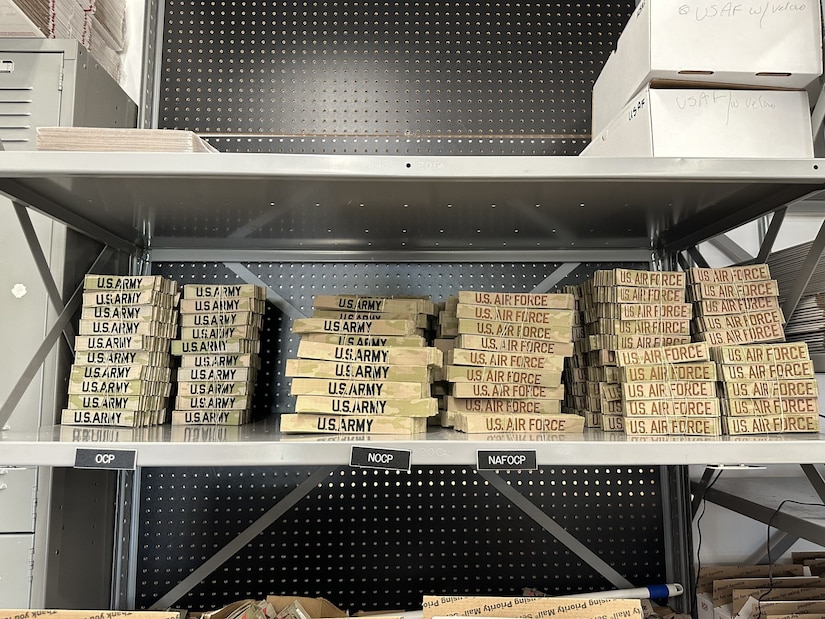
A majority of service members in uniform can be identified by their last name thanks to the fabric, plastic or metal name tag that's generally attached over their right breast pocket. It's a small piece of the uniform, but it's the most important part for a handful of people at Fort Knox, Kentucky, who create hundreds of thousands of them a year for nearly every service member in the Defense Department.

The Name Tape Plant, which is run by the Army and Air Force Exchange Service, occupies an unassuming building at Fort Knox. But as you walk in, you can tell its small team of only 15 employees is hard at work creating quality products for U.S. military clothing stores all over the world.  


As their day begins, a cacophony of sound picks up, with dozens of sewing machines quickly punching needle and thread through spools of camouflaged fabric used for combat uniform tags known as name tapes. The plant has eight automated machines that can embroider four name tapes at a time, while two additional machines can do 12 at a time — mostly Air Force and Army tags.

"In the beginning, it was intimidating, but it's not that hard once you train," explained Delta Hodges, who said she had no professional sewing experience when she took the job 20 years ago.


Three single-head automated machines sew name tapes for every branch, while three more sew luggage tags, keychains and other miscellaneous items that service members request. Separate non-automated machines are used for hand-sewing Velcro onto name tapes if a service member has selected that option.

"We turn out about 2,000 to 3,000 pieces a day. That's about 15,000 a week, so you're talking about 60,000 in a four-week period," said Name Tape Plant manager Teresa Green, whose crew receives orders daily and ships them out just as fast.

There used to be three shifts that kept the plant running 24/7, but there's only one shift now that runs Monday through Friday.


The plant is certified by the Institute of Heraldry, the designer of insignia for various U.S. government agencies and the armed forces. It also certifies and approves all the specifics for each set of name tapes, which are different for each branch and type of uniform. For instance, the length and width of each name tape varies, as does the color thread that's used for each service. The institute also has to approve which certified manufacturer the plant can order that thread from.

" gives you, like, a micro-third of an inch to be off. It's very little," Green said. "They're very particular."


Each time a uniform is updated, such as the changes to the Army and Air Force combat uniforms a few years ago, the Institute of Heraldry informs the plant. But Green said that rarely affects their production process.

"If they do something specific to the name tag itself ... that's when we have to get involved," she said. "The Air Force did have dark midnight blue thread at one time, but that blended in too much, so that's why they went with the dark brown — they can see their names more clearly."

Two automated engraving stations at the plant carve more names into plastic tags for various dress uniforms. Pedro Medina, a Marine Corps veteran, has worked at the plant since 2010 and runs the engravers, creating up to 400 tags a day.


Afterward, fellow co-worker Matthew Darcy coats the plastic tags with epoxy. It takes a steady hand to do it well, making sure to not let one tag's epoxy bleed into another's. Darcy then moves on to the meticulous part — using a small toothpick-like tool to make the epoxy cover the entire tag, as well as to bring pockets of air bubbles to the top.  Next, he uses a small blow torch to heat the epoxy to pop those trapped bubbles.

"It's one of those things where once you start, you can't stop. You have to get it done," Darcy said.

The epoxy takes about seven hours to dry and harden completely; however, to cut down on that time, the plant also uses a UV light machine that can finish the job in about two hours.


The plant also makes plated-silver metal name tags for Air Force dress uniforms. The only service that doesn't use the plant for orders is the Navy, which began requiring its own exchange to make sailors' tags and name tapes in 2019.

At the end of the entire process, two employees act as quality control to make sure each tag is perfect before preparing them to ship.

The plant's workers range in age from young to old, veterans to civilians, retirees to full-timers. Green said some employees come in with sewing experience, but it's not required. Placement at the various machines is based on need, and each employee runs the same machine every day so they become efficient. However, they each know how to run every machine.

"Everybody's cross-trained," Green said, including two workers who went to school to learn how to fix the machines if they break down.


Many of the plant's employees have worked at the facility for more than a decade — a longevity that's indicative of it being a pretty solid place to work.

"I think making employees happy — you work for them, and they work for you," Green said.

For that handful of workers, it's a labor of love and thanks.

"The people here really care about the military. They are supportive. Most of them, their husbands are retired , and they want to do the best job they can because they know what the military family goes through," Green said. "They all take great pride in their jobs."

Right


ABOUT   NEWS   HELP CENTER   PRESS PRODUCTS
Facebook   Twitter   Instagram   Youtube

Unsubscribe | Contact Us


This email was sent to sajanram1986.channel@blogger.com using GovDelivery Communications Cloud on behalf of: U.S. Department of Defense
1400 Defense Pentagon Washington, DC 20301-1400

Alert: UN condemns deadly West Bank airstrike, attacks on Gaza schools

Welcome to the United Nations
View in browser
Click 'Download images' to view images
UN News
Global perspective Human stories
Alert 4 October 2024
UN condemns deadly West Bank airstrike, attacks on Gaza schools
[UN News photo]

The UN chief has strongly condemned the killing of several Palestinians, including women and children, who died when a residential building in Tulkarem camp in the West Bank was hit by Israeli airstrikes on Thursday night.

Read more
UN logo white
facebook twitter soundcloud
COPYRIGHT    |    FAQ    |    FRAUD ALERT    |    PRIVACY NOTICE    |    TERMS OF USE
Unsubscribe    |    Update preferences

Today in DOW: July 13, 2026

...